Open or closed AI models — which to pick as a beginner and why
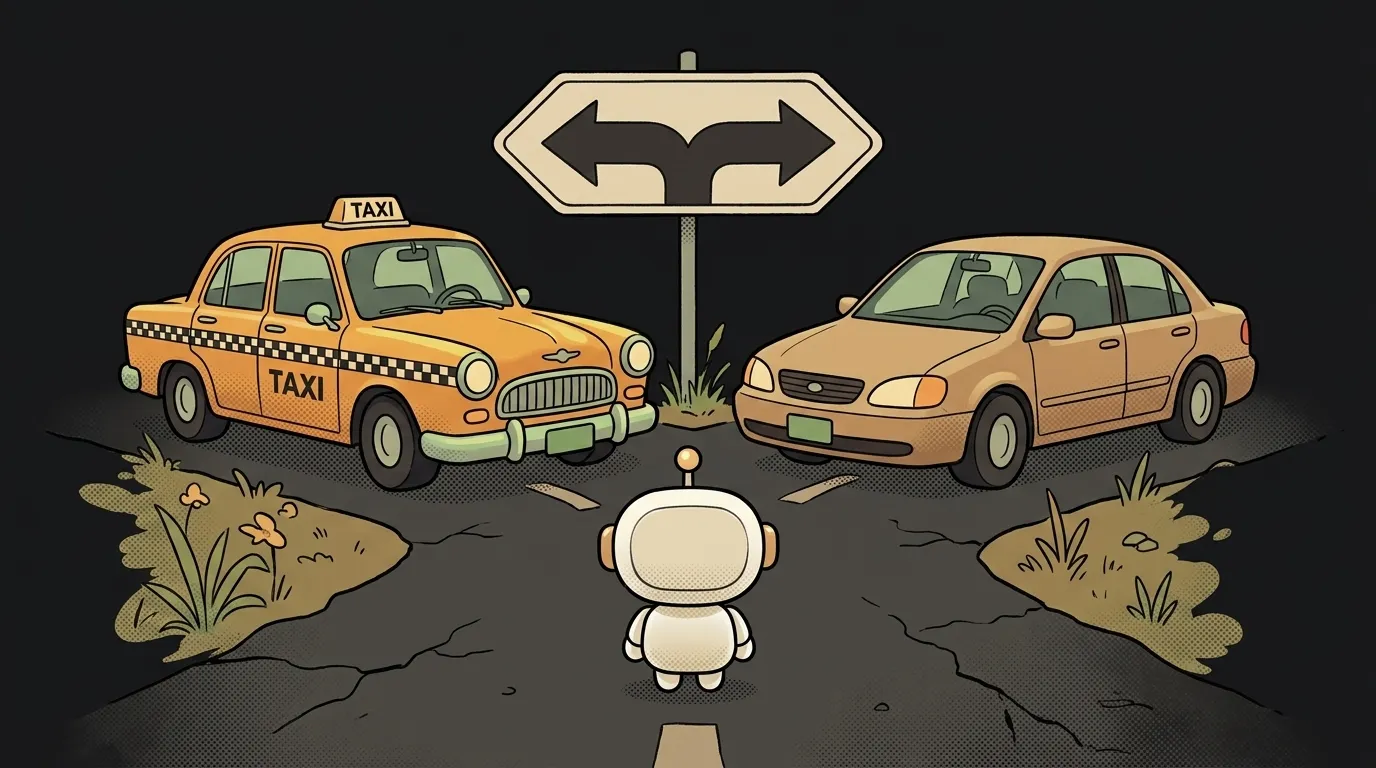
Let's clear up the confusion almost every beginner trips on. An "open" model isn't "free," and a "closed" one isn't "the best." It's about who owns the model and where it runs, not about quality.
The fairest analogy: a closed model is a taxi. Get in, give the address, ride, pay per trip — the car isn't yours and the rules aren't yours. An open model is your own car. Pricier up front and you have to know how to drive, but it's yours, it runs without the internet, and nobody can take it away. Now to the substance.
What the words even mean
A closed model (GPT, Claude, Gemini) lives on the company's servers. You don't see its internals and you reach it through an API — send a request, get a response, pay for volume. You can't download it and run it yourself.
An open model (Llama, Qwen, GLM, DeepSeek) is a weights file the company released publicly. You can download it and run it on your own server or even a powerful laptop. More precisely it's called "open weights" — the model's parameters are released, not necessarily the whole training code.
The comparison that matters
| Criterion | Closed (taxi) | Open (own car) | |-----------|---------------|----------------| | Start | Got a key — working in 5 minutes | Have to deploy and configure it somewhere | | Cost | Pay per request | Pay for server/hardware, requests are "free" | | Privacy | Data leaves to someone else's servers | Data never leaves your machine | | Quality | Usually top-tier, especially on hard tasks | Catching up; on simple tasks already level | | Control | Vendor changes rules and prices | Your version forever, nobody can switch it off | | Internet | Always needed | Can run offline |
Who should pick which
No fluff, direct calls.
Take the closed one (taxi) if you're just starting, building a prototype or an app for people, and you want the best quality from minute one. 95% of vibe coders at the start — that's you. Don't burn energy on servers — grab a key to Claude or GPT and build the product. One tip: keep the key in environment variables, not in code.
Take the open one (own car) if you have one of three reasons: data can't go outside (medical, legal, private journals), you have so many requests that the API gets expensive, or you need offline use and independence from a vendor. You usually reach these reasons after the first month, not in it.
A common pattern is to combine: prototype on a closed model (test the idea fast), and once you've grown and are counting money, move part of the load to an open one. That's normal and widely done.
FAQ
Are open models really free?
The model itself — yes, free to download. But you have to run it on something: either your own hardware or a rented server with a GPU — and that costs money. "Free" here means "no per-request fee," not "zero cost."
Are open models much worse than closed ones?
They used to be noticeably worse; now the gap is closing fast. On simple tasks (summarizing, classification, basic chat) good open models are already level. On the hardest things (long reasoning, subtle code) closed ones still lead, but not by miles.
Where should a beginner start?
With a closed model via API — the path of least resistance. Get a key, make your first request, see the result in minutes. Leave open models and your own server for later, when a concrete reason appears: privacy, cost, or offline.
Short story-lessons, an agent simulator and daily practice — in our mobile app. Free.
Read next

What is SSH — how to log into someone else's computer without a password in the open
What is hashing — why a website doesn't know your password

What is a race condition — the bug that shows up only sometimes
Docker or a virtual machine — the difference, and what a beginner should pick
What is WebSocket — and why a chat updates itself without a page reload