What are embeddings — and how AI knows that 'cat' and 'kitten' mean the same
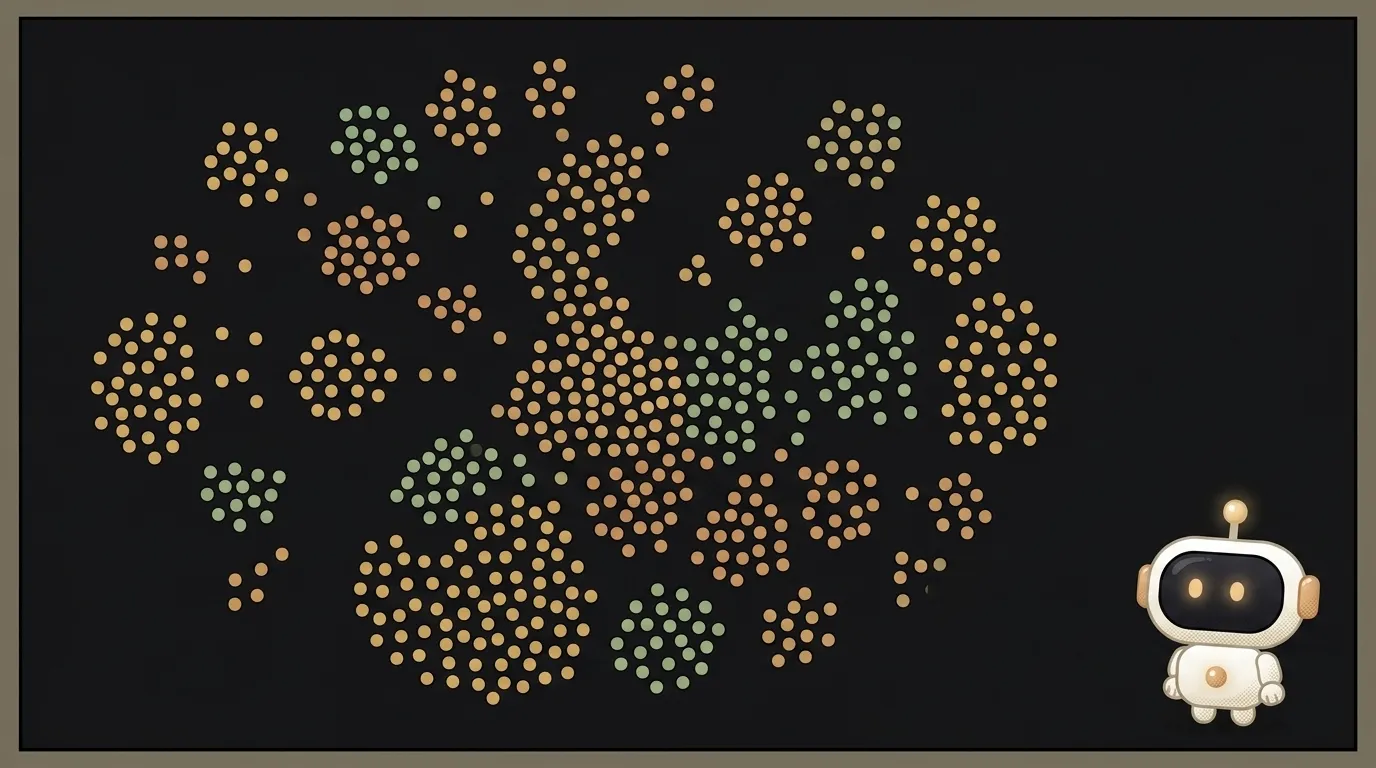
Here's a clever thing. How does AI know that "cat" and "kitten" mean almost the same? But "cat" and "tractor" don't?
It doesn't understand words the way we do. Yet somehow it tells close from far.
The trick is this: AI turns every word into a point on a map. And it places words with close meanings near each other. That point is an embedding.
A word turns into coordinates
Picture a huge map. Only it doesn't hold cities — it holds meanings.
AI takes a word and drops it onto this map. The point gets coordinates: just a list of numbers. That switch from "text → numbers" is what we call an embedding.
Why numbers? Because numbers are easy to compare. With coordinates, it's obvious what's close and what's far. With words, it isn't.
And here's the main move: AI places the points by meaning.
- "cat", "kitten", "feline" — right next to each other, in one corner of the map;
- "tractor" — somewhere far away, over by the machinery;
- "dog" — not far from cat: also a household animal.
The map isn't flat, of course. It doesn't have two axes — it has hundreds. But the idea is exactly the same: near means similar, far means different.
Search by meaning, not by words
Now, here's what it does for you.
Ordinary search looks for exact words. You ask "how to start a car in the cold" — but the text says "engine startup in winter". Different words, and ordinary search might miss it.
Embedding search compares not letters but points on the map. "Start a car in the cold" and "engine startup in winter" are neighboring points. They share almost no words, yet the meaning is one. And AI sees that.
So it finds what you need even when you said it in different words. That's what "search by meaning" means.
Where you've already met it
Embeddings aren't textbook theory. A pile of everyday things runs on them.
- "Similar items" and recommendations. A shop shows you similar things because their points sit close on the map.
- Smart search in notes or email. You search by meaning, not the exact word — and still find it.
- AI that answers from your files. First it uses embeddings to find the right piece among hundreds of pages, then it answers. This trick is called RAG — there's a separate piece on it.
Spot the pattern? Anywhere AI has to figure out "what is this even about" — under the hood there are points on a map of meaning.
What to take away
You don't need to memorize formulas. One image is enough.
AI doesn't compare words letter by letter. It lays meanings out on a map and looks at what's nearby.
Once you hold that map in your head, it stops being surprising that search gets you from half a word, and recommendations are sometimes eerily spot-on. Close meanings are simply close points.
Short story-lessons, an agent simulator and daily practice — in our mobile app. Free.