What is a neural network — in plain words (and why nobody programmed it)
Here's a strange truth: the code that tells a cat from a dog was written by nobody. Not a single line like "if it has whiskers and pointy ears, it's a cat." The neural network worked it out on its own. Stranger still — not even its creators can point to where inside the "knowledge about cats" is stored.
Sounds like magic. It's actually a simple mechanism, repeated millions of times. Let's unpack it without a single formula.
What a neural network is
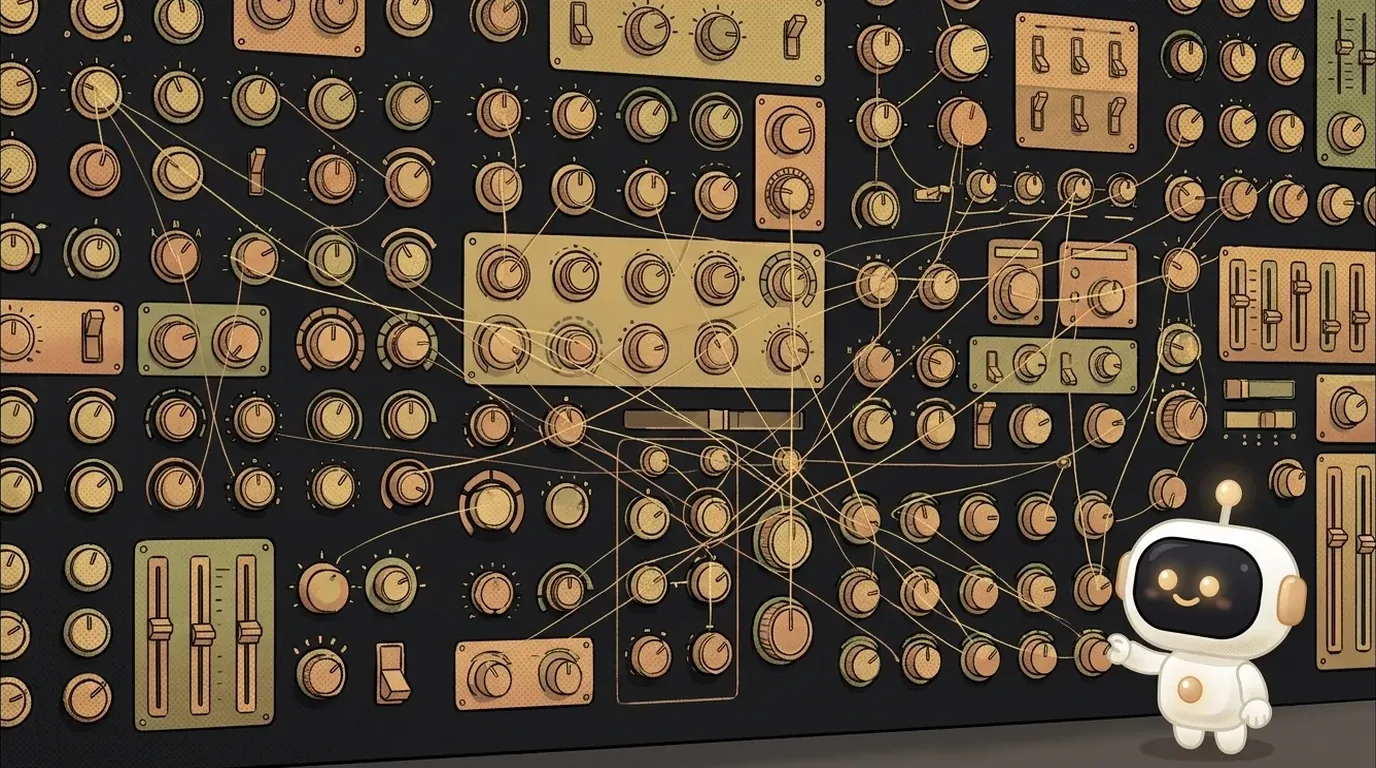
A neural network is a big table of number-settings that data is pushed through. Those numbers are called weights. Each weight is like a volume knob: a little louder, a little quieter. There are millions of them, sometimes billions.
You feed in something — an image, text, sound. The data passes through layers of these knobs and comes out the other end as an answer: "cat," "spam," "Paris."
The whole trick is how the knobs are set. Set them at random — garbage out. Set them right — a meaningful answer out. The only question is: who turns them?
Where the right settings come from
A human doesn't set them. Training does — and this is the beautiful part.
- The network is shown an example with a known answer: a photo of a cat.
- It guesses. At first, randomly: "dog."
- The error is measured, and every knob is nudged slightly toward where the error is smaller.
- Repeat. Millions of times, over millions of examples.
Gradually the knobs settle into settings where the answers come out right — not just on familiar photos, but on new ones. The network didn't memorize the pictures. It found the shared features: shapes, textures, edges. (By the way, text gets sliced into tokens and turned into numbers first too — otherwise there'd be nothing for the knobs to act on.)
"Neuro" in the name is because the idea was borrowed from the brain: simple "neuron" cells linked together, with connections that can be stronger or weaker. But it's inspiration, not a copy. Inside, it's just numbers and multiplication.
Why this matters to you
Three things follow from this mechanism — and you hit them every day.
Networks need data, not instructions. Want it to recognize your receipts — show it receipts, don't describe them in words. Data quality decides more than any "genius algorithm."
It runs on probabilities, not guarantees. The answer is always "most likely," never "definitely." That's why even the best model sometimes misses — and why large language models, also built on neural networks, hallucinate.
Inside, it's a "black box." Since no rules were written, none can be read back. You can see the weights, but you can't explain in plain words why the network decided the way it did. Whole labs work on this.
The link to the AI you actually use
ChatGPT, image generators, voice assistants — all huge neural networks. A large language model (LLM) is a neural network trained to continue text. Face unlock on your phone is a neural network for images.
What differs between them is the architecture (how the layers connect) and the data (what they trained on). But the core principle is identical: turn the knobs until it guesses right. Get that, and all modern AI stops being magic and becomes an understandable tool.
Is a neural network like a brain?
No — it's a brain-inspired metaphor. A real neuron is thousands of times more complex, and we don't fully understand how the brain works. In a neural network a "neuron" is just a number and a couple of operations. The resemblance is elegant but shallow.
How much data does it take to train a neural network?
Depends on the task. A simple classifier learns from thousands of examples. Big models like ChatGPT need terabytes of text and months of data-center time. For your own projects you usually don't train from scratch — you take a ready model and just nudge it slightly.
Short story-lessons, an agent simulator and daily practice — in our mobile app. Free.
Read next
What is SSH — how to log into someone else's computer without a password in the open
What is hashing — why a website doesn't know your password
What is a race condition — the bug that shows up only sometimes
Docker or a virtual machine — the difference, and what a beginner should pick
What is WebSocket — and why a chat updates itself without a page reload