What is MCP — the single port that gives AI its 'hands'
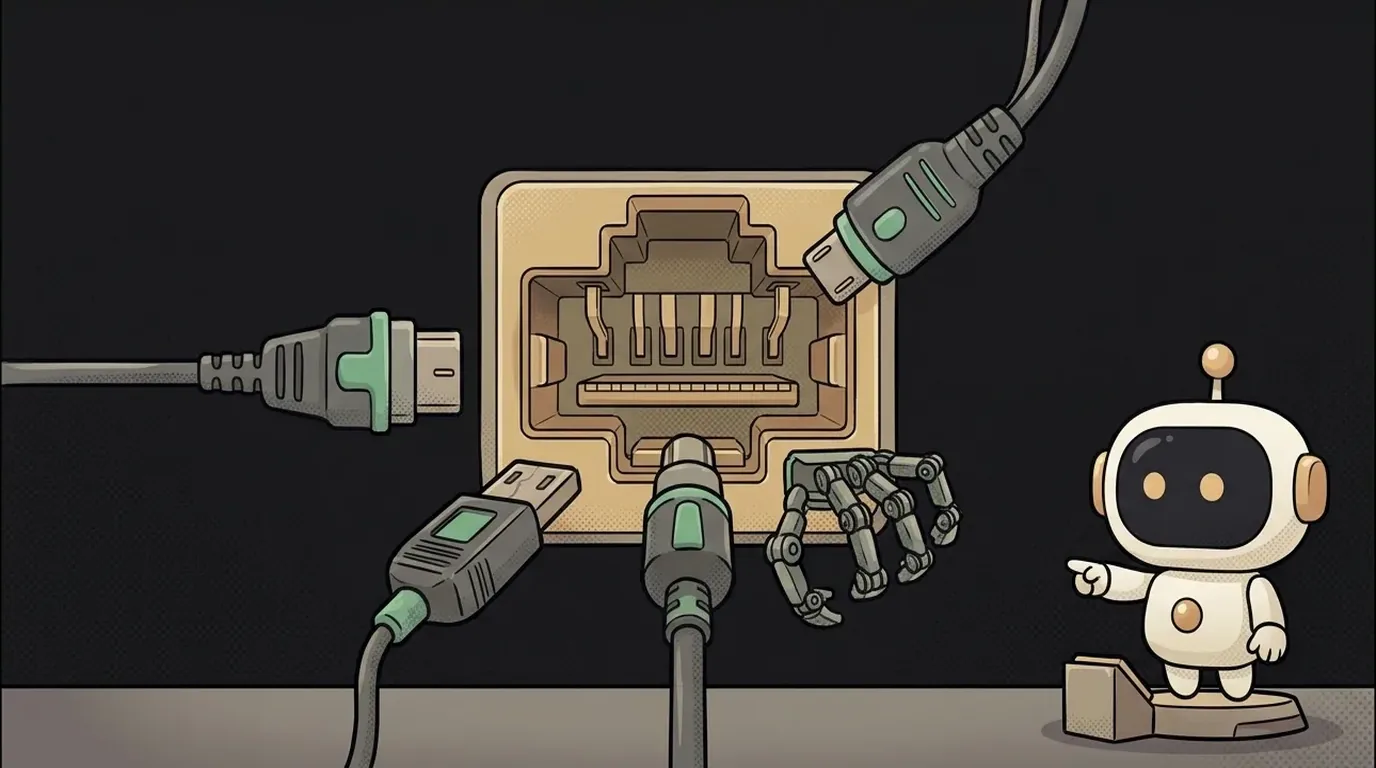
On its own, an AI agent is locked in a box. It can think and talk — but it can't see your files, can't reach the internet, can't open a database. Just text, back and forth.
For it to actually do something, it needs "hands": access to a browser, to a database, to your documents.
And the single, shared way to plug those hands in — that's MCP.
MCP is like USB for AI
Remember life before USB. Every gadget had its own port. One charger for the phone, another for the player, a special cord for the mouse. A drawer full of cables, and none of them fit anything else.
Then USB arrived — one port for everything. Plug it in, it works.
Tools for AI had the same headache for a long time. Want to connect an agent to a database? You write a custom adapter. To files? Another one. To a messenger? A third. Every agent-and-tool pair, from scratch, by hand.
MCP clears out that zoo. It's one common port: agree on how an agent and a tool talk, and from then on everything connects by a single rule. That's why people call it "USB-C for AI".
What changes in practice
Before: every tool was wired to the agent by hand, its own way. Slow, and easy to break.
With MCP: a tool is built once "with an MCP port" — and any agent that knows the port understands it. Build the socket once, and anyone can plug in.
And this isn't one company's pet idea. MCP came out of Anthropic in late 2024 and was handed to everyone as an open standard right away. Other big players have already picked it up — OpenAI among them. When the port is shared, everyone wins.
Why this matters to you
You probably won't be building MCP ports by hand. But you'll hear about MCP constantly — and now you won't be lost.
- Giving an agent a tool — a browser, a database, your notes — usually means "set up an MCP server". Now you know what that means.
- Seeing "MCP support" on an editor or agent — it means new hands are easy to add. That's a plus, not an empty badge.
- Picking a tool — ask whether it speaks MCP. If it does, it'll get along with your agent without a fight.
The picture to keep in your head: the agent thinks, and MCP gives it hands — through one common port. The more hands an agent has, the more it can actually do, instead of just talking.
Short story-lessons, an agent simulator and daily practice — in our mobile app. Free.