What is machine learning — and why nobody wrote the rule for “this is a cat”
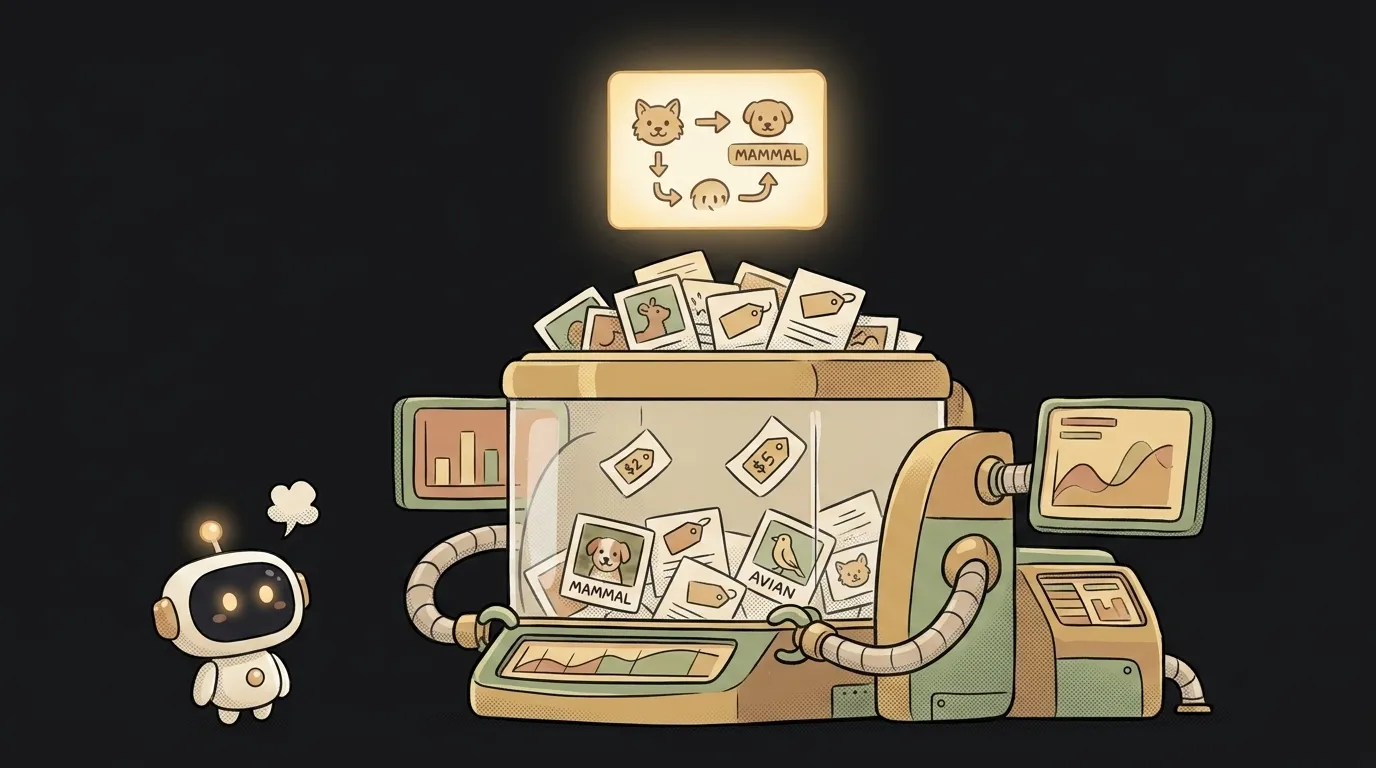
Here's the surprising part. A normal program is written as rules: "if the email contains the word 'winner' → spam." Now try this: write a rule that tells a cat from a dog in a photo. You'll get stuck on line one. Ears? Dogs have pointy ones too. Whiskers? Not always visible.
So here's the thing: the rule for "this is a cat" was never written. The machine figured it out itself, after looking at thousands of photos. And the weirdest part — even the person who trained it can't point to where "cat" is stored inside. In a couple of minutes you'll see how that happened.
What it is — code that learns from examples
Machine learning (ML) is a way to solve problems with examples instead of rules.
Compare the two approaches:
- Normal program: a human writes rules → the program applies them to data → out comes an answer.
- Machine learning: a human gives data and answers → the program finds the rules itself → those rules apply to new data.
We flip the arrow. Rules used to be the input. Now they're the output. You show the system 10,000 emails labeled "spam / not spam," and it works out for itself which features give spam away. Nobody sits down and writes the word list by hand.
That's the "learning" in the name: not memorizing, but finding a pattern in examples.
How it works — examples instead of rules
Let's take a toy case. We want to predict an apartment's price.
- Collect examples. Thousands of apartments: floor area, floor number, district — and the real price they sold for. Those are your "correct answers."
- The model guesses. At first it stabs in the dark: names a price at random and misses.
- Measure the error. By how much did it miss? A million? Fine, note it.
- Nudge. The model tweaks its internal settings a little so next time it misses less. Then repeats steps 2–4 a few million times.
Gradually the error drops. At some point the model predicts prices for apartments it has never seen. It didn't memorize the answers — it found a pattern: "bigger area → pricier, farther from center → cheaper," plus dozens of subtler links a human couldn't put into words.
This is exactly how a neural network works: those "internal settings" are its weights, and nudging them on examples is the training. When there are billions of those settings and the whole internet for examples, you get a large language model like ChatGPT.
Why it matters to you
Sounds like theory. But this one idea explains three things beginners trip over.
First: why AI is sometimes confidently wrong. The model doesn't "know" the right answer — it found a pattern in examples. If the examples were skewed, the answers will be too. Garbage in → garbage out.
Second: why "give it more data" actually works. More good examples → a sharper pattern. It's not magic or marketing: ML quality grows directly with the quality and quantity of the data the model learned from.
Third: how ML differs from the normal code you write with AI. When you vibe-code a website, that's ordinary rules — an assistant just writes them for you. But the assistant itself, inside, is ML. It helps to feel the line: where it's deterministic code, and where it's a "trained guesser."
Where you've already met it
Spoiler: everywhere.
- The recommendation feed in a social app — ML predicting what will hold your attention.
- Autocomplete on your keyboard — predicting the next word.
- Face unlock, the spam filter, translation, voice input.
- Every ChatGPT reply is ML at the moment of inference — predicting the next chunk of text.
None of these were "programmed" with rules head-on. All of them learned from examples.
Is machine learning the same as artificial intelligence?
No — ML is a part of AI, the most practical part today. "Artificial intelligence" is a broad umbrella (old rule-based systems counted too). Machine learning is one specific approach under it: learning from data. Almost everything called "AI" right now is ML.
Do I need math to use it?
To build models from scratch — yes, it helps. To use ready-made ones (call a model via API, build an app with AI) — no. You work with a trained model like a black box: give an input, get an answer. Understanding the idea helps; deriving the formulas isn't required.
Is machine learning the same as deep learning?
Deep learning is a subset of machine learning where the patterns are found by a neural network with many layers. All deep learning is ML, but not all ML is deep — plenty of models are simpler, with no neural network. It's the deep networks specifically that drove the leap of recent years — image recognition and language models run on them.
Short story-lessons, an agent simulator and daily practice — in our mobile app. Free.
Read next

What is a string in programming — and why "5" and 5 aren't the same

What is return and a return value — and why console.log returns nothing

What is a boolean — and why the string "false" is actually true
for loop or map — which to use, and why await inside map doesn't wait

What is scope in programming — and why a variable is "not defined" when it's right there