What is refactoring — why change code that already works
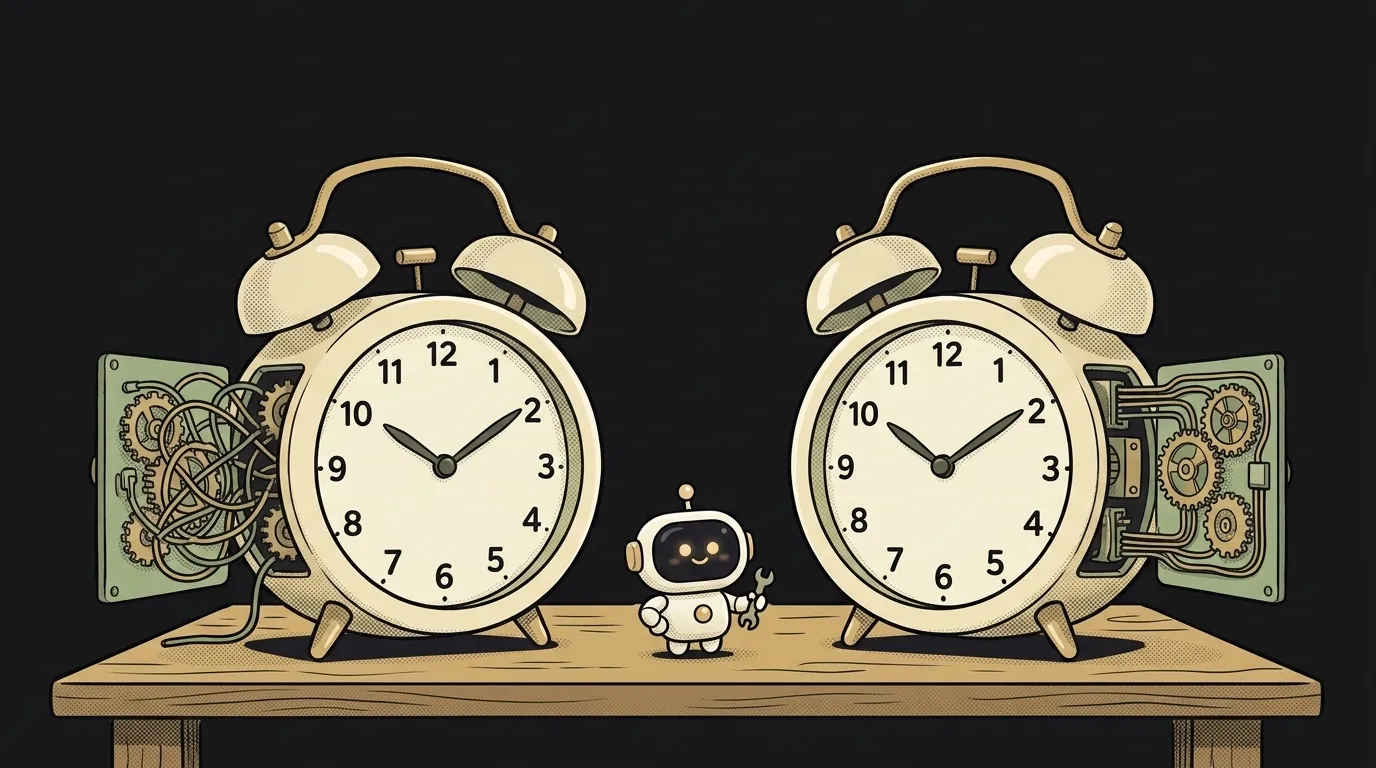
There's a strange kind of work: you spend an hour editing code — and by the end, the app does exactly what it did in the morning. Not a single new button. And that counts as an hour well spent.
That's refactoring. It comes with one hard rule that explains a lot: if the app behaves differently after you "cleaned up the code" — that wasn't refactoring. That was breaking things.
What is refactoring
Refactoring is changing how code is built without changing how it behaves. On the outside — everything as before. On the inside — clearer, shorter, tidier.
The analogy is tidying your kitchen. You're not cooking new dishes: you put the knives where they belong, throw out three identical can openers, label the jars. Dinner tonight is the same. But cooking tomorrow is faster and nicer.
Martin Fowler cemented the term — his book Refactoring came out back in 1999. The problem is older than AI: code gets written once and read dozens of times.
Why touch what already works
"If it works, don't touch it" sounds wise, but the rule has an expiry date.
Code gets read far more often than written — even in your own project. Every new feature starts with reading old code. The messier it is, the more expensive every next step becomes.
With AI, you feel this faster than with humans. A model happily copies similar chunks instead of reusing one — and twenty requests later you have five nearly identical functions. While you're asking for a new feature, AI breeds bugs exactly in places like these: one copy gets fixed — four stay stale.
The moment "don't touch it" stops working is easy to recognize: you add one feature — two neighboring ones break.
What it looks like
Three typical examples — notice that none of them changes behavior:
- Rename. A variable called
databecomesuserList. The code does the same thing, but the next reader (you, a month from now) doesn't have to guess what's inside. - Pull out duplicates. The same chunk in three places becomes one function called three times. Fixes now happen in one place.
- Slice the wall of code. An eight-hundred-line file becomes three files split by meaning: logic, interface, data access.
Sounds small? That's the point. Refactoring is many small safe steps, not "let's rewrite everything from scratch." A from-scratch rewrite is exactly the riskiest path.
By the way, the signals that say "time to tidy up" have their own name — "code smells." Duplication, a two-hundred-line function, a variable called data2 — that's them. When the term shows up in an AI answer, know this: it's about reasons to refactor, not actual breakage.
How to refactor with AI
Four rules, and they're cheap.
- Don't mix. "Add a feature and clean up the code while you're at it" is the worst prompt: if something breaks, you won't know which of the two edits did it. One pass — one goal.
- Commit first. Before the cleanup, save the working state — a commit gives you a point you can always roll back to.
- Ask explicitly. The formula: "Refactor this file. Don't change the behavior. Explain every change." That last part is your control: an explanation you don't understand is a reason to ask, not to accept.
- Verify yourself. After the refactor, run the app through its main flows. "Behavior didn't change" is verified with your eyes, not taken on faith — it's part of the skill of reading AI-generated code.
Bonus: AI sometimes offers to "refactor this" on its own. Now you know what it means — and can say yes deliberately, as a separate pass.
Is refactoring the same as optimization?
No. Optimization changes how fast code runs; refactoring changes how readable it is. Sometimes code gets faster after a cleanup, but that's a side effect, not the goal.
How often should I refactor?
A little and constantly, not one "big cleanup" a year. The boy scout rule works well: leave the code a bit cleaner than you found it. Spotted a confusing name while building a feature — rename it in the next pass.
Short story-lessons, an agent simulator and daily practice — in our mobile app. Free.