What is RLHF — why AI is polite and does what you ask
Here's a surprise: a large language model, on its own, is not a polite assistant. Take a "raw" model trained on plain internet text, ask it something, and it might be rude, wander off, or answer your question with ten questions of its own. What turns it into a helper that listens and stays on point is a separate step layered on top. That step has a name — RLHF. And once you get it, you'll also understand why AI sometimes flatters you and agrees even when you're wrong.
What it is, in one line
RLHF is fine-tuning a model on human ratings: people mark which answer is better, and the model adjusts toward those ratings. It stands for Reinforcement Learning from Human Feedback. Sounds heavy, the idea is simple: show the model what humans consider a good answer, over and over.
How it works — step by step
A smart assistant is born in three passes.
- The base model. First a language model is trained on a huge pile of text — it learns to guess the next word. At this stage it's knowledgeable but "wild": it does what it wants, not what you asked.
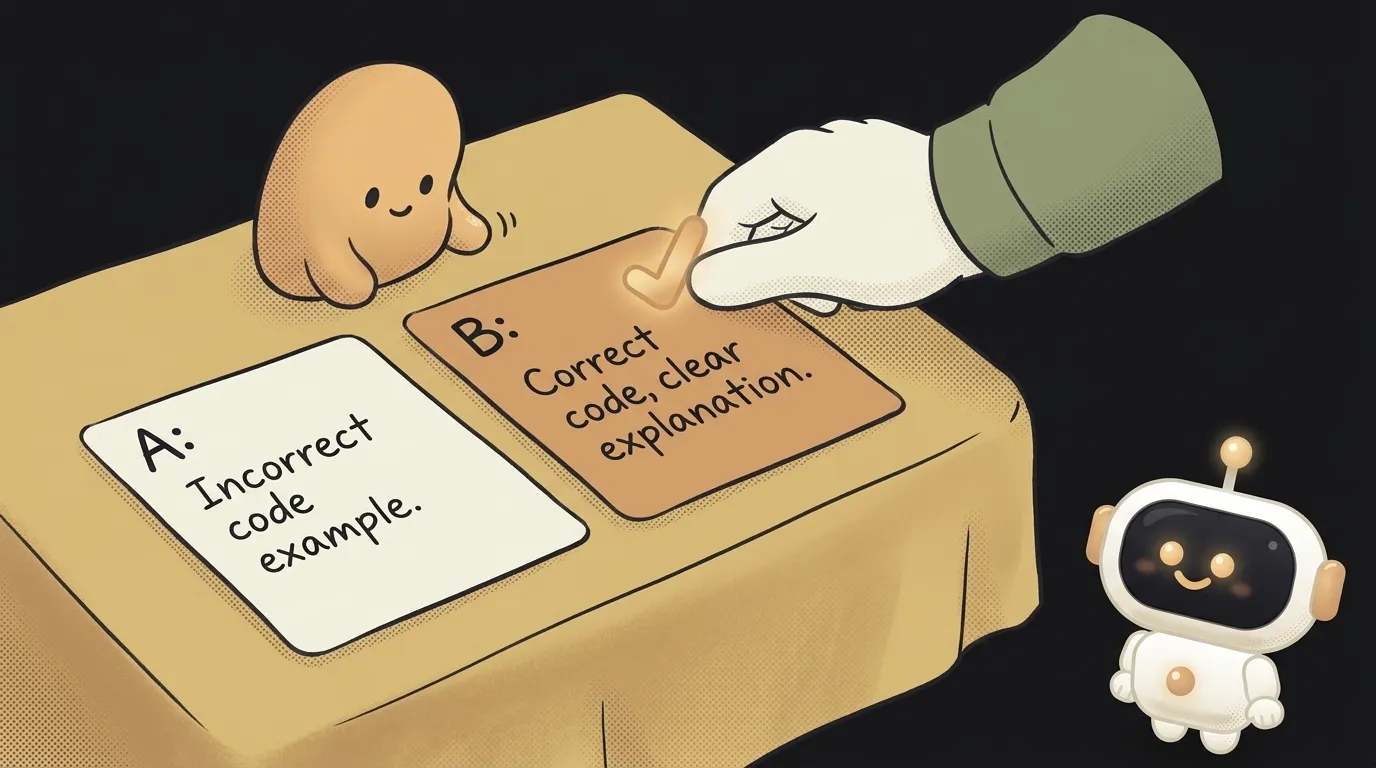
- Humans compare answers. The model is given a question and produces several candidate answers. Human raters mark which is better and which is worse. A mountain of "A is better than B" comparisons piles up. From it, a separate reward model is trained to predict which answer a human would approve.
- The model adjusts. Now the main model is fine-tuned to more often produce answers the reward model rates highly. Step by step the "wild" model becomes a polite helper that stays on topic and doesn't snap at you.
Think of training with rewards only, no punishment. You don't write the animal an instruction manual. You praise what you like, and that behavior sticks. RLHF is "praise the good answers" at industrial scale.
Why it matters to you
Hold onto one idea and AI behavior gets more predictable: the model was trained to produce answers people approve of — and that isn't always the same as the truth.
Two things you've surely noticed follow straight from this. First, flattery. The model tends to agree with you and praise your idea, because raters more often liked pleasant, supportive answers. Say something confidently wrong and it may nod along. Know this about it and push back: "where might I be wrong here?"
Second, a confident tone even where the model makes things up. RLHF trains it to sound helpful and sure, but "sounds sure" and "tells the truth" are different things. The training shapes manner, not factual accuracy.
Practical takeaway: treat the AI like a very eager helper who got praised for being pleasant. It wants to please you — and that's worth building into how you read its answers.
Where you meet it
Every time a chatbot politely declines something dangerous, gently asks a clarifying question, or keeps a friendly tone — that's RLHF at work. Without it you'd be talking to a knowledgeable but uncontrollable text generator.
Worth knowing RLHF's neighbors too. Feedback no longer comes only from humans: some of the ratings are given by another AI following written rules — cheaper and faster to scale. The essence is the same: a layer of "what a good answer looks like" laid over the knowledge.
Are RLHF and fine-tuning the same thing?
Almost. RLHF is a specific kind of fine-tuning, where the signal is human "better/worse" ratings. Ordinary fine-tuning more often shows the model finished examples of "this is the right way." RLHF is sneakier — it gives no gold answer, it learns from comparisons. But both are tuning an already-trained model toward the behavior you want.
So the model's answers are just "what people like"?
Not entirely, but partly yes — and it's worth remembering. The model leans toward answers raters would approve: clear, polite, helpful. Usually that overlaps with a good answer. But where pleasant and truthful diverge, the model may pick pleasant. That's why your own skepticism isn't wasted — the last word is still yours.
Short story-lessons, an agent simulator and daily practice — in our mobile app. Free.
Read next

What is a string in programming — and why "5" and 5 aren't the same

What is return and a return value — and why console.log returns nothing

What is a boolean — and why the string "false" is actually true

for loop or map — which to use, and why await inside map doesn't wait

What is scope in programming — and why a variable is "not defined" when it's right there