SQL or NoSQL — which to pick for a first project, no dogma
There's so much heat around "SQL vs NoSQL" you'd think it's a choice of religion. In practice it's simpler for a beginner than it looks, and in this piece we'll say outright what to take. But first — a short, honest difference, so the choice is informed rather than "I copied the tutorial."
Both are databases — the long-term memory of an app. The difference is in how they store data.
The core difference
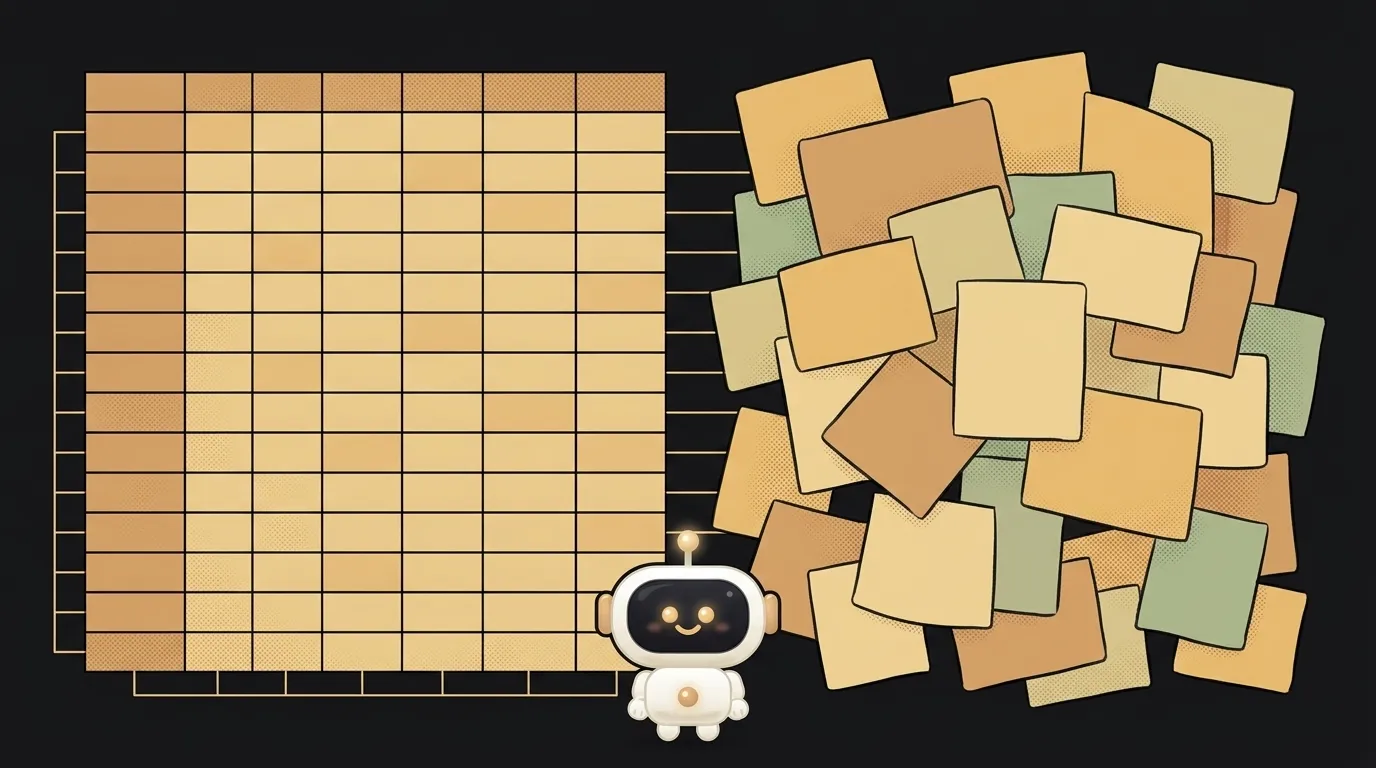
A SQL database stores data in strict tables. You define the columns and their types up front (name — text, age — number), and every row must follow that structure. Tables can reference each other: orders link to users. It's like a neat filing system with rules.
A NoSQL database stores data more loosely — usually as document-cards. Each record is a standalone card, and different cards can have different fields. No rigid schema in advance: want to add a field to one record — you just add it. It's like a box of free-form notes.
A comparison that matters
| Criterion | SQL | NoSQL | |-----------|-----|-------| | Structure | strict, defined up front | flexible, fields as you go | | Relations between data | a strength (orders ↔ users) | you assemble them by hand | | Learning curve | clear: tables like Excel | easier at the start, harder at scale | | Where it shines | linked data: users, orders, payments | varied/changing data, high throughput | | Queries | the SQL language, a shared standard | each database has its own way | | Examples | PostgreSQL, MySQL, Supabase | MongoDB, Firebase Firestore |
The key practical row is "relations." In almost any app, data is linked: a user has notes, an order has products. SQL is built exactly for this and pulls "all of Anya's orders" in one query. In NoSQL you maintain such links by hand, and that's the pain beginners hit latest.
Who should pick what
Plainly, no "it depends":
Take SQL if you're building an ordinary app: users, their data, some records, payments. That is — nearly everything a beginner builds. The data is visible, the relations are clear, and an AI agent generates code for it confidently. Services like Supabase give you a SQL database on a free tier — the best default to start with.
Look at NoSQL if your data has no clear structure or changes shape often: an event feed, logs, chat messages, a cache. Or you're taking Firebase for its ready bundle (auth + database + hosting in one) and deliberately accept its document model.
If you're unsure, take SQL. It's not the "safe boring choice" — it's the one that covers 90% of first projects and is easiest to learn. When you hit a real reason to switch, you'll know it, and the move will be a deliberate one.
Can I use both at once?
Yes, and mature projects often do: SQL for the core linked data (users, orders), NoSQL or a fast cache for streaming things. But that's a later optimization. A beginner has no reason to start with two databases — it's complexity without an upfront payoff.
Question: is NoSQL faster than SQL?
Not in a general sense. NoSQL can be faster on specific tasks — simple key reads at huge throughput. But on linked data SQL is often faster and certainly more convenient. "Faster" depends on the task, not the label; for a first project the speed difference won't touch you at all.
Question: if I pick SQL, will I get stuck later?
No. SQL is the most portable data skill there is: one language is understood by nearly every database and every AI tool. Learn it and you'll easily read and fix any generated query. And if you ever need NoSQL, you add it alongside without throwing away what already works.
Short story-lessons, an agent simulator and daily practice — in our mobile app. Free.
Read next
What is SSH — how to log into someone else's computer without a password in the open
What is hashing — why a website doesn't know your password
What is a race condition — the bug that shows up only sometimes

Docker or a virtual machine — the difference, and what a beginner should pick
What is WebSocket — and why a chat updates itself without a page reload