What is a GPU — and why AI runs on graphics cards built for games
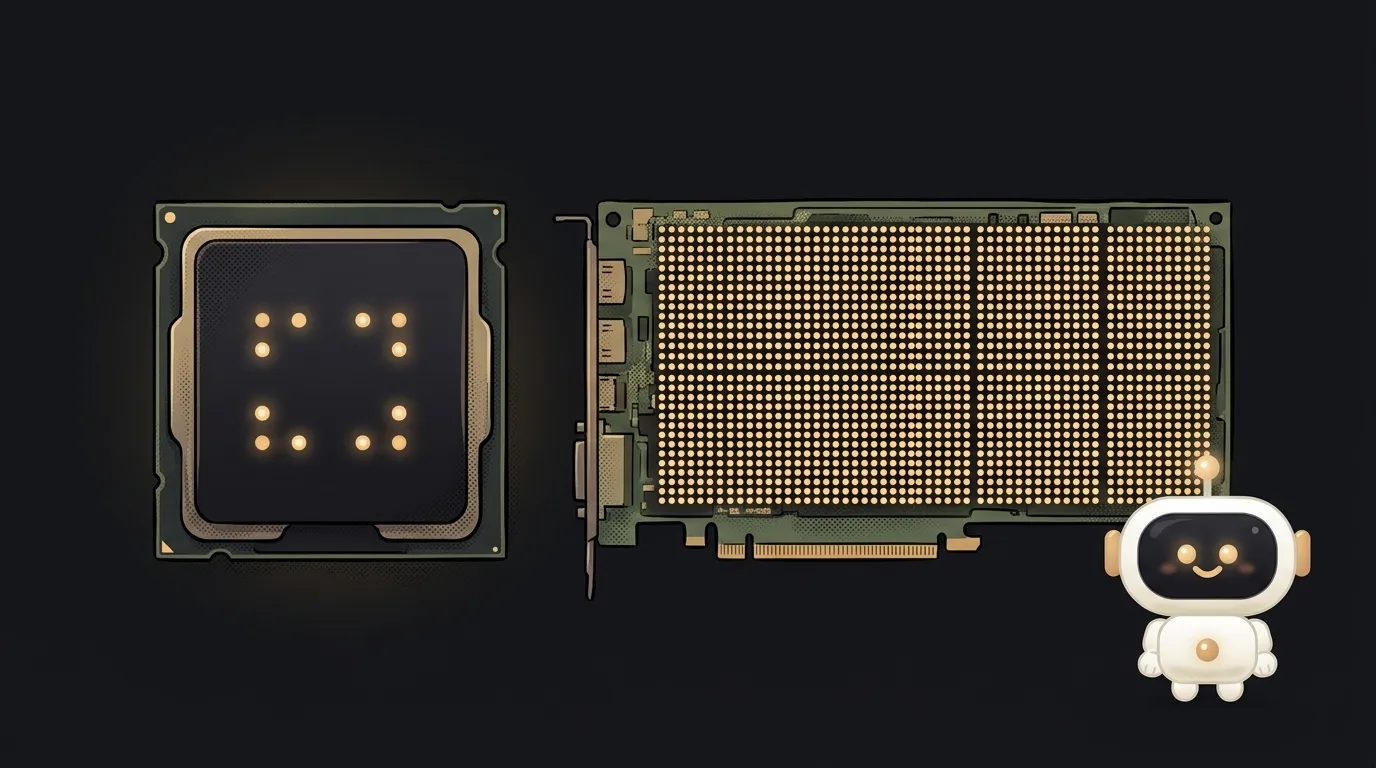
A strange-looking truth: artificial intelligence runs on graphics cards. The same ones you put in a computer for pretty pictures in games. When people say "not enough GPUs for AI" or "the company bought thousands of graphics cards," they mean literally the chip that draws games. How did that happen? Let's unpack it — and it'll explain half the AI headlines you read.
What a GPU is, in plain words
GPU stands for Graphics Processing Unit. In everyday terms — the graphics card (or, more precisely, its main chip). Its original job was one thing: draw millions of pixels on screen, very fast, so a game wouldn't stutter.
There's always a second brain next to it — the CPU, the central processor. It runs the whole computer. The difference between the two is the key, and it's where the whole point hides.
CPU vs GPU — a few smart workers vs a thousand simple ones
Picture it this way. A CPU is a couple of very smart workers. Each takes a complex task and does it step by step, in order. Great when there aren't many tasks, but they're tricky.
A GPU is thousands of simple workers. Each one can do a little, but there are loads of them, and they all work at the same time. Bad for one tricky task. But perfect when you need to do a million identical small calculations at once.
Drawing a game is exactly a million identical operations: work out the color of each pixel. That's why graphics cards were built this way.
What this has to do with AI
Now the twist. Inside a neural network, almost all the work is multiplying huge tables of numbers by each other. Millions of identical small operations. Exactly what the graphics card was made for.
It turned out to be an accidental but perfect match. Hardware polished for decades for games happened to be precisely what's needed to train and run models. So:
- Training a large model without a GPU is nearly impossible — on an ordinary processor it would take years.
- Every request you send to an AI (inference) is computed on graphics cards in a data center.
- GPUs became scarce and cost as much as a car — there's a real race for them between companies.
The takeaway that stays with you: when you hear "we need more GPUs," translate it as "we need more of that gaming hardware, because AI is a mountain of identical multiplications."
Do you need a GPU?
To build apps with AI — almost certainly not. You reach the model over the internet, and the graphics cards spin somewhere in a data center, not in your home. You pay for the answer, not the hardware.
A GPU at home helps in one case: if you want to run an open model on your own computer, with no internet. Then the graphics card (or even a recent laptop) does the work itself. But you don't need it to start — begin with models over the network.
Are a GPU and a graphics card the same thing?
In casual talk, yes. The graphics card is the whole board; the GPU is its main chip, which does all the work. Conversations rarely distinguish them, and that's fine.
Why does everyone talk about NVIDIA?
NVIDIA makes most of the GPUs modern AI runs on, plus the software for them. That put the company at the center of the whole boom — its chips are the scarce thing everyone's after.
Short story-lessons, an agent simulator and daily practice — in our mobile app. Free.
Read next

What is a string in programming — and why "5" and 5 aren't the same

What is return and a return value — and why console.log returns nothing

What is a boolean — and why the string "false" is actually true
for loop or map — which to use, and why await inside map doesn't wait

What is scope in programming — and why a variable is "not defined" when it's right there