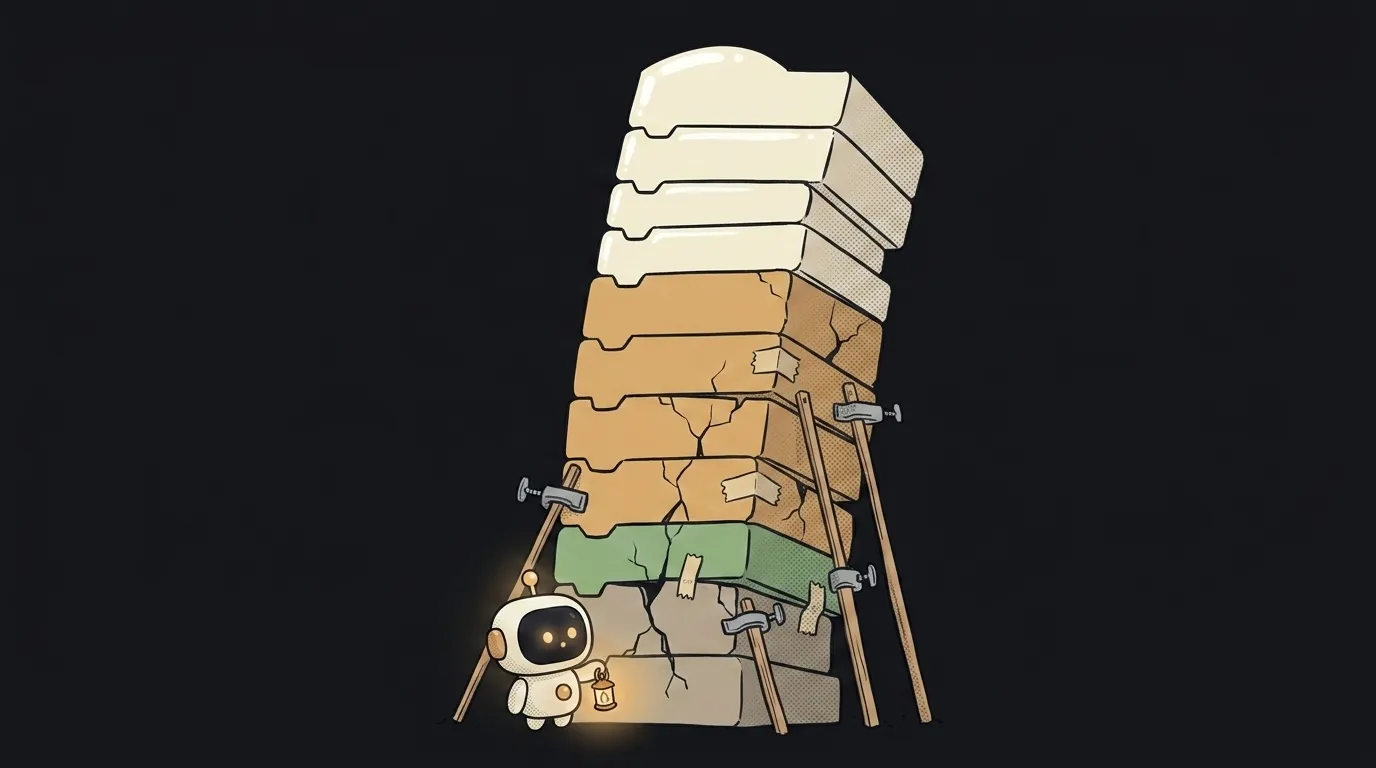
What are open weights — and why it's not the same as open source

Look, here's a confusion that springs up out of nowhere. A model gets called "open" — and you think, "oh, like open source, all the code is out there." But what you actually got is just the finished result: the numbers inside the model. How they came to be, on what data — that's often closed. "Open weights" and "open source" are different things, and the difference is worth understanding before you download your first model.
What "weights" are — and why they are the model
Any language model is, at heart, a giant table of numbers. Those numbers are called weights: the model tuned them during training, and all its skill is baked into them. When the model answers, it multiplies these numbers. The weights are the brain.
"Open weights" means the company published those numbers for everyone. You download them — and you've got a full, working model you can run yourself.
How that differs from open source
Here's the key point. Open source in the classic sense means everything needed to reproduce the product is open: the sources, the build recipe. For a model, "fully open" would mean three things: the weights + the training code + the data it was trained on.
Open weights usually give you only the first — the finished numbers. The recipe (how exactly it was trained) and especially the data are most often closed.
| What you get | Open weights | Full open source | |--------------|:------------:|:----------------:| | Download and run the model | yes | yes | | Fine-tune it yourself | yes | yes | | Training code | sometimes | yes | | The data it learned on | almost never | yes | | Reproduce the model from scratch | no | yes |
An analogy: you're handed a finished, working cake and allowed to slice and decorate it however you like. But you weren't given the recipe or the ingredient list. You can't bake the exact same one from scratch — but you can use it and remake it to your taste all you want.
That's why the well-known "open" models (Llama, Qwen, DeepSeek) are more correctly called open-weight, not open source: the weights are open, the data isn't.
What it gives you in practice
Even without the recipe, open weights are a lot. With the model in hand you can:
- run it locally — on your own computer, free and private, without sending data to someone's cloud;
- fine-tune it for your task (see fine-tuning);
- not depend on a single company — the model is yours, nobody "switches it off" or hikes the price tomorrow.
Big models are heavy, but they get shrunk with quantization, and many open models run fine on a regular laptop.
And the license? "Open" doesn't mean "do whatever"
An important trap. You can download the weights, but what you're allowed to do with them is set by the license. Some open models are free even for commercial use (licenses like Apache 2.0 or MIT are the safest). Others have caveats: restrictions for very large companies, say. If you're going to sell a product built on such a model — read the license before you wire it in. Two minutes that save big problems.
By the way, this is one of the axes when choosing open vs closed models — privacy and control against the convenience of a ready cloud.
Q: Are open weights free?
The weights themselves — almost always yes, you download them for nothing. But "free to download" doesn't equal "free to use in a product": that's the license's call. And running costs resources — a big model needs powerful hardware or a paid cloud. The file is free; the whole venture isn't necessarily.
Q: How is an open model different from ChatGPT or Claude?
ChatGPT and Claude are closed: you reach them over the internet, the weights aren't given to you, the company owns the model. An open model you download and keep on your own machine. Closed ones are usually smarter at the peak, but open ones are more private, cheaper at scale, and entirely under your control.
Q: Can I run an open model on my laptop?
A small or mid-size one — sure, especially in a compressed (quantized) form. Giant ones need a serious GPU. Simple rule: look at how many gigabytes the model weighs and compare it to your memory. If it fits, it runs.
Short story-lessons, an agent simulator and daily practice — in our mobile app. Free.
Read next
What is SSH — how to log into someone else's computer without a password in the open
What is hashing — why a website doesn't know your password
What is a race condition — the bug that shows up only sometimes
Docker or a virtual machine — the difference, and what a beginner should pick
What is WebSocket — and why a chat updates itself without a page reload