What is a small language model (SLM) — and why it runs without the internet
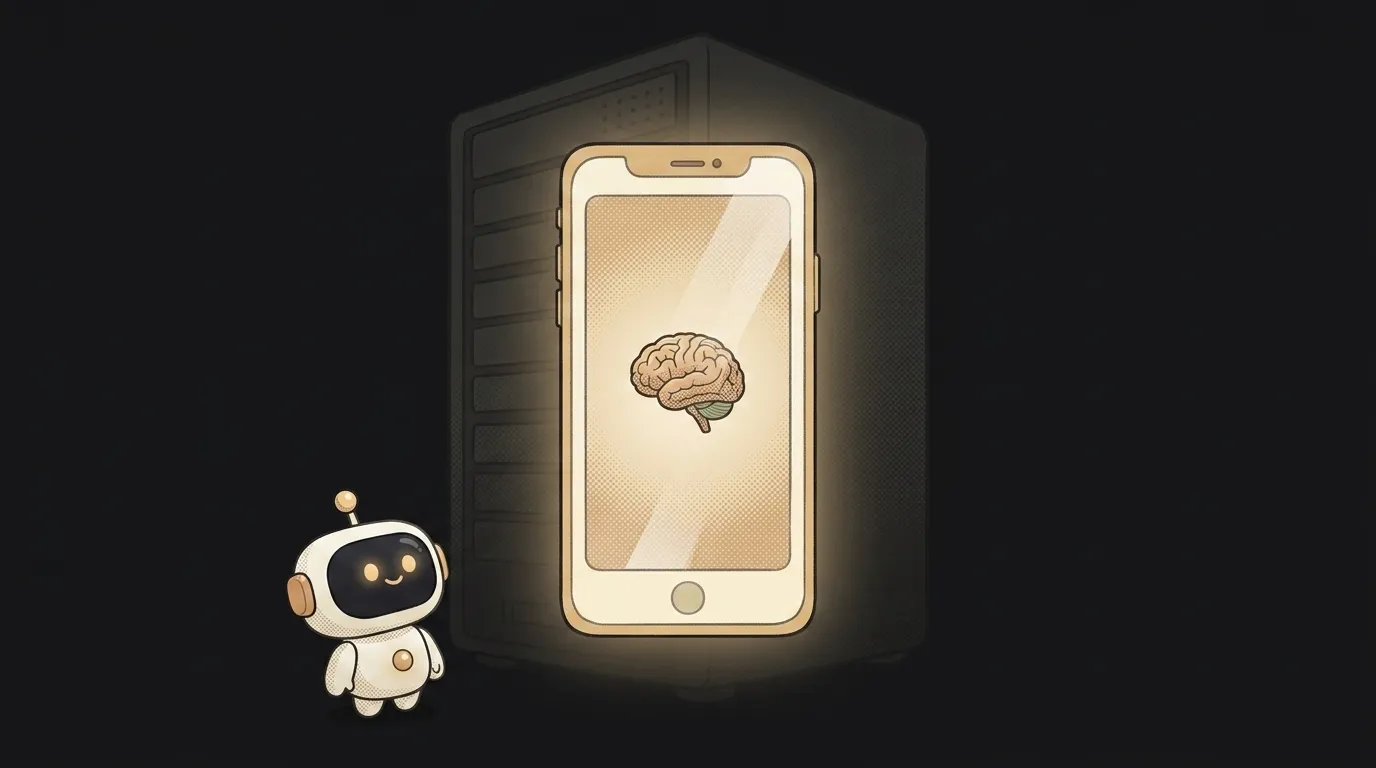
Here's a surprising one: an AI model the size of a single song on your phone can now match last year's giant on plenty of tasks. And it runs right in your pocket — no internet, no bill for every request.
These are called SLMs — small language models. Give it a couple of minutes and you'll see why "small" stopped meaning "dumb".
What it actually is
An SLM is a language model, just a compact one. Its little sibling, if you like: same idea as the big models, but many times smaller.
Model size is measured in parameters — the "settings" that training produces by the billions. A big model has hundreds of billions. A small one has from one to about eight billion. The difference is a truck versus a motorbike: both drive, but they take up and burn very different amounts.
The main consequence: an SLM fits on ordinary hardware. Not a data center — your phone, your laptop, a cheap server.
Small, yet it holds up
Here's the twist. A couple of years ago a small model was clearly dumber than a big one. Today the gap has nearly closed on everyday tasks. Why?
- It's not just size — it's the data. The model is trained on a cleaner, more deliberate set of texts, so it wins on quality, not quantity.
- Specialization. Small models are often tuned for one narrow job (translation, code autocomplete, parsing emails). On its own task it beats a general-purpose giant.
- Compression. A trick called quantization shrinks a model with almost no loss of quality, so it fits and runs faster.
Bottom line: for "rewrite this politely", "pull the date out of this text", "suggest the next line of code", a huge model is overkill. A small one does it instantly and locally.
To make it concrete: a 3-billion-parameter model takes a couple of gigabytes — like a small phone game. It needs no data center and no constant internet: download it once and run it. A 300-billion giant can't afford that — it lives on someone else's servers and charges for every request you make. That's why "small" often means not "worse", but "closer to you".
Why it matters to you
Even if you never build AI yourself, SLMs change three things for you.
- Privacy. The model runs on your device — your text never leaves. For personal notes, health data, work secrets, that's a huge difference.
- Offline and speed. No internet? It still answers. And it answers without the round trip to a server.
- Cost. A local model doesn't meter each request. Start it once and run it as much as you want, for free.
The takeaway: choosing a model isn't "grab the biggest one". A small model running on your own machine often wins on privacy, speed and money — and that's enough. Reach for a big one only when the task is genuinely hard. How to decide per case is in how to choose an AI model.
Where you'll meet one
More often than you think. Autocomplete and the smart keyboard on your phone, on-device translation, voice input, the suggestions in your code editor — all of it often runs on small models right on the device.
And an SLM is easy to run yourself: there are open families like Gemma, Phi and the smaller Llama and Qwen — download and run them on your own laptop. Many ship with open weights, meaning you can freely take them and run them locally.
Is an SLM just a trimmed-down LLM?
Not quite. Yes, it's smaller and usually weaker at hard reasoning. But it wasn't "cut" from a big model — it was trained separately to be compact, and often tuned for a specific job. On its own task an SLM can beat a giant, not lose to it.
How much worse is an SLM than the big models?
Depends on the task. On simple, narrow work — the difference is barely noticeable. On complex multi-step reasoning the big model is still ahead. Simple rule: routine and privacy → SLM; hard logic → a big model.
Can I run an SLM without a powerful computer?
Yes, that's the whole point. Many small models run on an ordinary laptop or even a phone. The more a model is squeezed by quantization, the humbler the hardware it needs — at the cost of a slight quality dip.
Will SLMs soon replace the big models?
No — they're not rivals, they're different tools. Big models handle the hardest stuff: deep reasoning, rare knowledge, long documents. Small ones take the mass of simple tasks right next to you, cheaply and privately. The future isn't "one wins", it's "big in the cloud for the hard stuff, small on the device for the everyday". You'll use both, often without noticing which.
Short story-lessons, an agent simulator and daily practice — in our mobile app. Free.
Read next

What is a string in programming — and why "5" and 5 aren't the same
What is return and a return value — and why console.log returns nothing

What is a boolean — and why the string "false" is actually true
for loop or map — which to use, and why await inside map doesn't wait

What is scope in programming — and why a variable is "not defined" when it's right there