What is a vector database — and why it finds “dog” when you type “puppy”
Here's the surprising part: a normal database only finds a row if you type it almost word for word. Ask for "puppy" when the row says "dog" and it shrugs — no match. A vector database finds it anyway, because it searches by meaning, not by letters. And that changes what kinds of apps you can build.
What it is
A vector database is storage that searches by meaning, not by exact word match. You ask in your own words, and it returns the closest thing by content — even if none of your words appear in it.
A normal database is like a phone book: know the exact name, get the number; misspell it, miss. A vector database is like a seasoned librarian: say "something about pets" and they bring the right books, even though the word "pets" isn't on any cover.
How it works
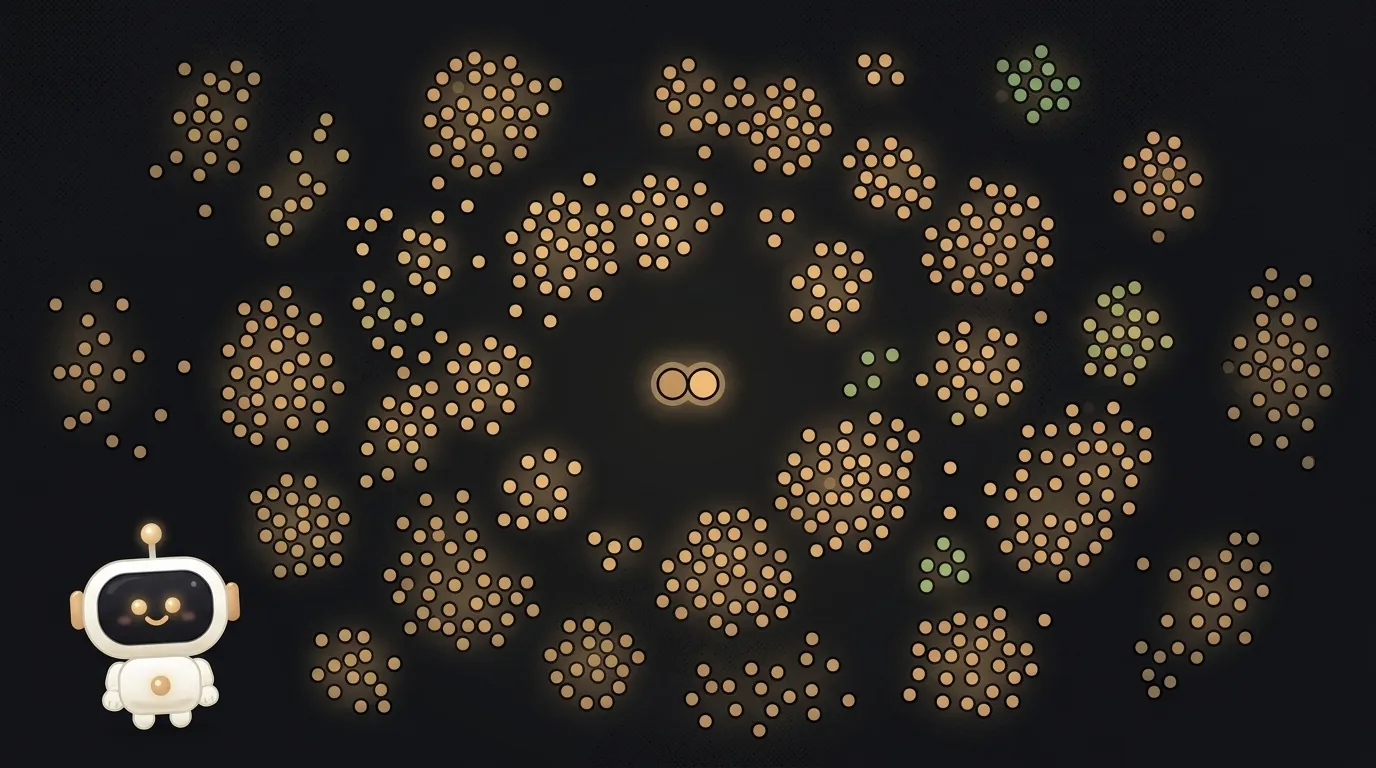
The whole trick is one step: text becomes numbers. Those numbers are called embeddings — coordinates of meaning. Every word, phrase or whole paragraph gets its own set of numbers, and one simple rule holds: the closer the meaning, the closer the numbers.
Picture a huge map. "Dog" and "puppy" sit almost on top of each other — same meaning. "Cat" is nearby but a bit further. "Tractor" is on the far side. A vector database stores exactly these coordinates.
When you ask a question, here's what happens:
- Your question is turned into coordinates too — a point on the map.
- The database checks which stored points are closest to it.
- It returns them — that's "similar in meaning."
There's no magic understanding here. It's geometry: find the nearest points. The points are just arranged so that closeness on the map equals closeness in meaning.
Why it matters to you
The moment you want AI to answer from your data — your notes, your docs, your product catalog — you can't skip a vector database. The model on its own doesn't know what's in your files. The pattern is: you load your texts into a vector database, and on a user's question you pull out the couple of closest chunks and hand them to the model as a cheat sheet. That trick is called RAG — and the vector database is its heart.
Without it, you'd search by exact words and constantly miss: a user asks "how do I get my money back" while the doc says "refund procedure" — plain search finds nothing. Vector search finds it instantly.
This unlocks a whole class of apps: meaning-based search in your own docs, a support bot on your knowledge base, "similar products," recommendations. Anything where "find what's close" beats "find an exact match."
Where you'll meet it first
Probably when you build a chatbot over your own material. Many services already bundle vector search: in Supabase it's the pgvector extension, and there are dedicated databases like Pinecone or Chroma. You won't compute coordinates by hand — you just load texts and ask. But knowing that points on a map of meaning sit underneath, you'll stop being puzzled when it sometimes returns "the wrong thing": by meaning, it really was close.
Question: does a vector database replace a normal one?
No — they work as a pair. A normal database holds exact data — names, prices, dates — and searches by exact conditions. The vector one handles search by meaning. A real app often runs both: one knows "who paid how much," the other knows "what's similar to this question."
Question: do I need to understand the math?
No. Coordinates, distances and embeddings are computed by the service for you. All you need is the picture: meaning is a point on a map, search is "find the nearest." With that model, even dense tutorials start to make sense.
Short story-lessons, an agent simulator and daily practice — in our mobile app. Free.
Read next
What is SSH — how to log into someone else's computer without a password in the open
What is hashing — why a website doesn't know your password
What is a race condition — the bug that shows up only sometimes

Docker or a virtual machine — the difference, and what a beginner should pick
What is WebSocket — and why a chat updates itself without a page reload