What is Big O notation — and why your code flew on 100 rows and died on 100,000
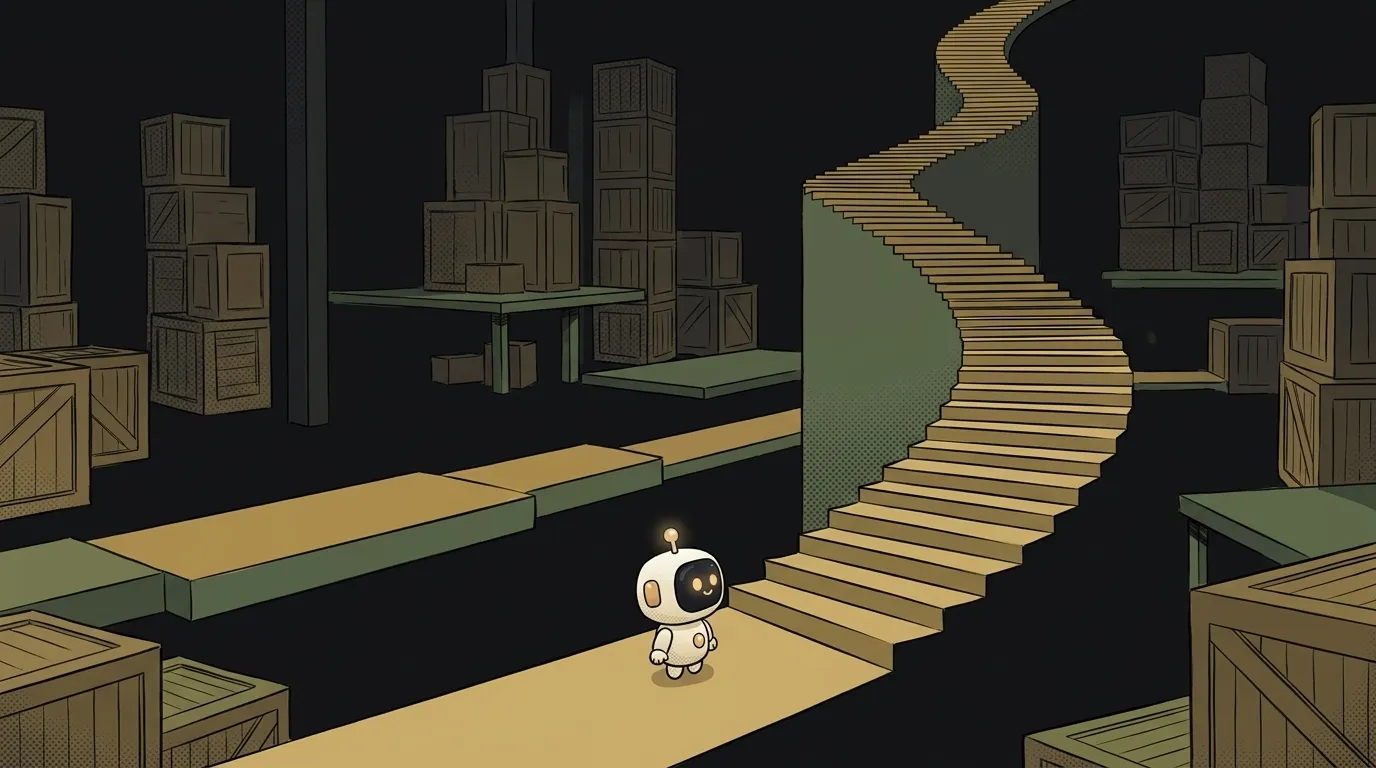
Here's a familiar story. You built a comparison of two lists, tested it on 100 rows — instant. Then you loaded the real 100,000-row file, and the tab froze for a minute.
The code didn't break. It does exactly what it did before. There's just 1,000 times more data, and a million times more work. That gap is what Big O describes.
What Big O is
Big O is the answer to "how much does the work grow when the data grows." Not "how many milliseconds" — how it grows.
That matters. Milliseconds depend on your laptop. Growth depends on the code itself. If the code grows like a square, no fast processor will save you: double the data, quadruple the work.
It's written like this: O(n), O(n²), O(log n). The letter n is the size of the data. How many rows, users, products.
Four growth rates you'll actually meet
Almost everything you write fits into four classes.
O(1)— constant. The work doesn't depend on size. Grabbing an array item by index,items[5], is one step whether there are 10 items or a million.O(log n)— logarithmic. Each step throws away half. A million items take about 20 steps. It's how you find a word in a dictionary: open the middle, decide left or right.O(n)— linear. One pass over all the data. Twice the data, twice the work. That's a plain loop or.filter().O(n²)— quadratic. A loop inside a loop. With 100 items it's 10,000 steps. With 100,000 it's already 10 billion.
That's the trap from the opening. On small data you can't see the difference between n and n². On big data it's the difference between a second and an hour.
Where the square hides
The sneaky part: O(n²) rarely looks like two nested for loops. More often it's hidden inside an ordinary method.
// find users that appear in both lists
const common = listA.filter(user => listB.includes(user))
It looks like one line and one pass. But includes is a loop too. It walks through listB until it finds a match. That's a pass inside a pass. Two lists of 100,000 — up to 10 billion comparisons.
The fix is swapping one structure:
const setB = new Set(listB)
const common = listA.filter(user => setB.has(user))
A Set doesn't search by walking — it looks things up by hash, in about one step on average. The code is now O(n). The same 100,000 rows take a fraction of a second.
A few more places where the square likes to hide:
indexOfandfindinside a loop — the same walk asincludes.array.shift()in a loop. It removes the first item and shifts all the others. A queue built onshift()over a big array is quadratic again.- Growing arrays or strings in a loop with spread —
result = [...result, item]copies everything collected so far on every step.
What Big O doesn't tell you
Big O is a rough estimate, and that's fine. It drops the details on purpose.
- Constants don't count. Two passes over an array is still
O(n). For growth, it doesn't matter. - On small data it's not the main thing. If a list will never hold more than 50 items,
includesin a loop is perfectly fine code. Don't turn every line into an optimization. - It usually means the worst case.
includesmight find the item right away. But plan for walking the whole list.
A practical rule: think about Big O wherever data can grow. File imports, search, feeds, anything that comes from users.
How to use this with AI
AI writes filter + includes all the time — it's shorter. Ask it to check:
Make this code fasterIn this code the lists can grow to 100,000 items.
Find places with O(n²) complexity or worse: loops inside loops, includes/indexOf/find inside filter or map, shift() in a loop.
For each place, write the current complexity, the new complexity and the fixed code.
Do not change the behavior.A good answer names a specific line and the "before/after" complexity. If the AI just rewrote everything "more nicely," ask it to prove where the square was. Then measure it to confirm it actually got faster.
Do I need Big O if AI writes my code?
Yes, at least the four classes. AI often picks the shortest code, not the fastest. To catch a square in review, the question "is there a loop inside a loop here?" is enough.
What does O(n log n) mean?
A bit slower than linear, but far faster than quadratic. That's the complexity of sorting: array.sort() in modern browsers runs in O(n log n). A million items sort in a fraction of a second.
Can Big O describe memory too?
Yes. The same notation estimates how much memory you need as data grows. The new Set(listB) above costs O(n) extra memory. Usually that's a fair trade: a little memory for a huge speed win.
Short story-lessons, an agent simulator and daily practice — in our mobile app. Free.
Read next
What is a source map — and why your error points to line 1, column 48213
What is a polyfill — and how one such script infected 100,000 sites

TCP vs UDP — what's the difference, and why your site probably already runs on UDP

What is an LRU cache — and why a cache with no limit becomes a memory leak

What is a sliding window — the trick that finds your 'best week' in one pass