A spell for your game — from one sentence, in pixels, with real impact
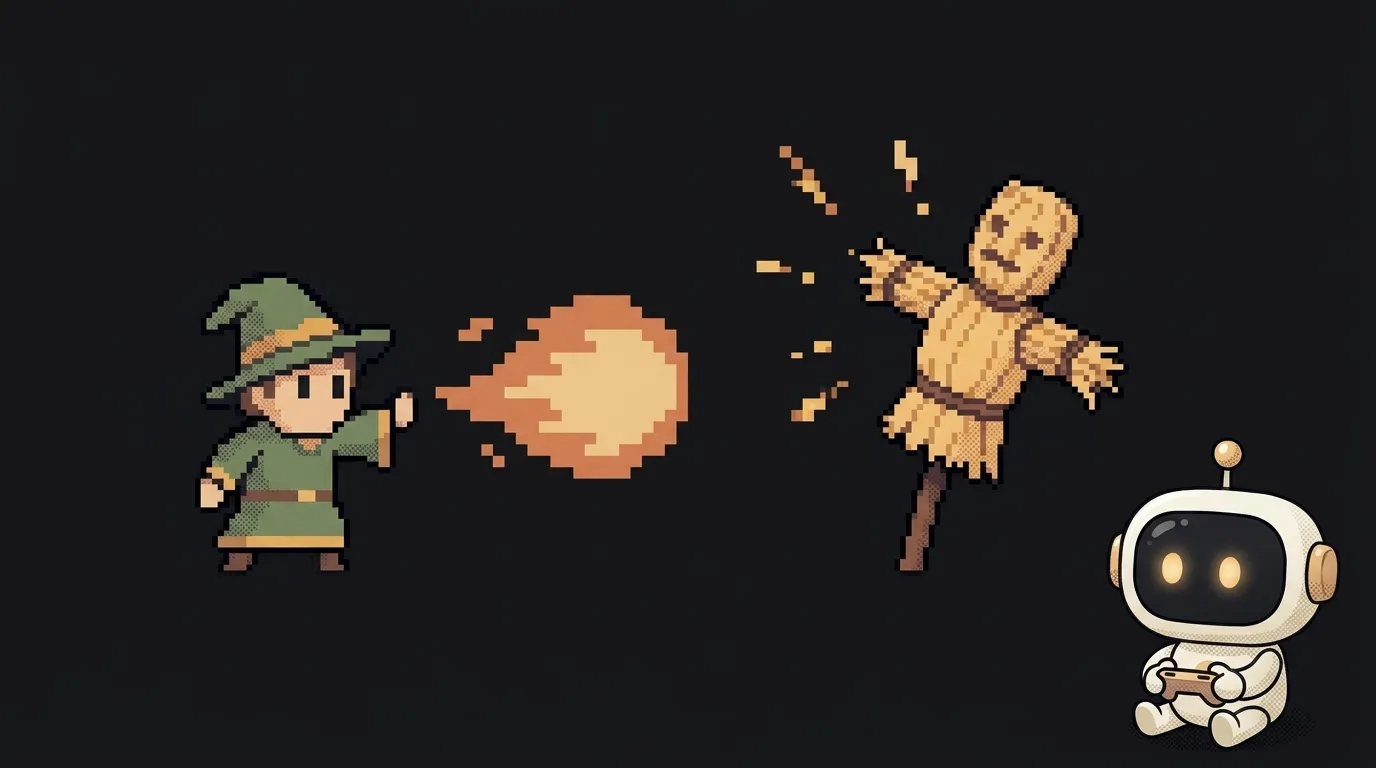
Here's a sneaky thing about hits in games. A pretty flash weighs nothing on its own. A hit feels heavy because of a pause: for a split second everything freezes on contact. In the library's example it's 0.14 seconds. Players never notice it — but without it, the hit feels like cotton.
The idea in one line: type "a fireball for my mage" and get a pixel effect with a wind-up, a flash, that exact pause and a target that rocks back. Straight into your browser game.
Why this only got easy now
Pixel art is a sore spot for AI. Image models draw it blurry: pixels smear, animations don't loop cleanly.
On October 30, 2026 pixelfx came out — an open library of 244 effects: fire, ice, lightning, explosions, magic, weather, coin pickups. The key part: every effect isn't an image but a small piece of code. Each frame is computed from time, so loops tile with no seam.
And it ships with a Claude Code skill. It makes new effects the way a picky pixel artist would: draft → render → look at the contact sheet → fix the worst thing → again. A separate checker catches pixels spilling over the edge, seams and randomness that makes a frame differ every run. The repo hit ~2,000 stars in two days.
What you'll learn
- How animation is defined in code, from time, not as a stack of images.
- What hit-stop is — the freeze on contact — and why a hit feels limp without it.
- How to work with an agent in a "make → look → fix" loop instead of one-shot prompts.
- How to drop a finished effect into a
<canvas>or export a sprite sheet for any engine.
Starter prompt
Install the skill in Claude Code with two commands:
/plugin marketplace add patch-gg/pixelfx
/plugin install pixelfx@pixelfx
Then precision wins. "Make a spell" gets you a random flash. Say what the game is, what the hit is and how it should feel:
Make me a spell effect for a game.Don't like it? Talk to it like an artist: "the hit feels limp — make it snappier", "add sparks on impact", "knock the target back further".
What you get
One page: your mage on the left, a straw dummy on the right. Hit "Cast" — wind-up, the ball flies, a flash, the world freezes for a beat, the dummy rocks back, sparks fade. All in crisp pixels, no blur.
Plus a folder of sprite sheets you can take into Godot or any other engine. The license is MIT — you can use the effects even in a commercial game.
Honest limits: you need Claude Code and Node. The agent's "render → look → fix" rounds spend your subscription's tokens. And the taste is your job: the agent offers three takes, you pick.
A year ago AI drew pixel art as a blurry picture. Now it writes it in code — and looks at what came out.
Short story-lessons, an agent simulator and daily practice — in our mobile app. Free.
Source: pixelfx — 244 pixel-art effects and a Claude Code skill (GitHub, patch-gg)
Read next
Does your app look like an AI made it? Let AI fix that
Saw a gorgeous animation on someone's site? Bring it home
Film a clip of a game that doesn't exist — then play it
You built an app with AI. Now draw its map — and ask it what will break
Fly down your own route in pixel art — with the buildings standing where they really stand