What is AI slop — and why it's not about writing quality
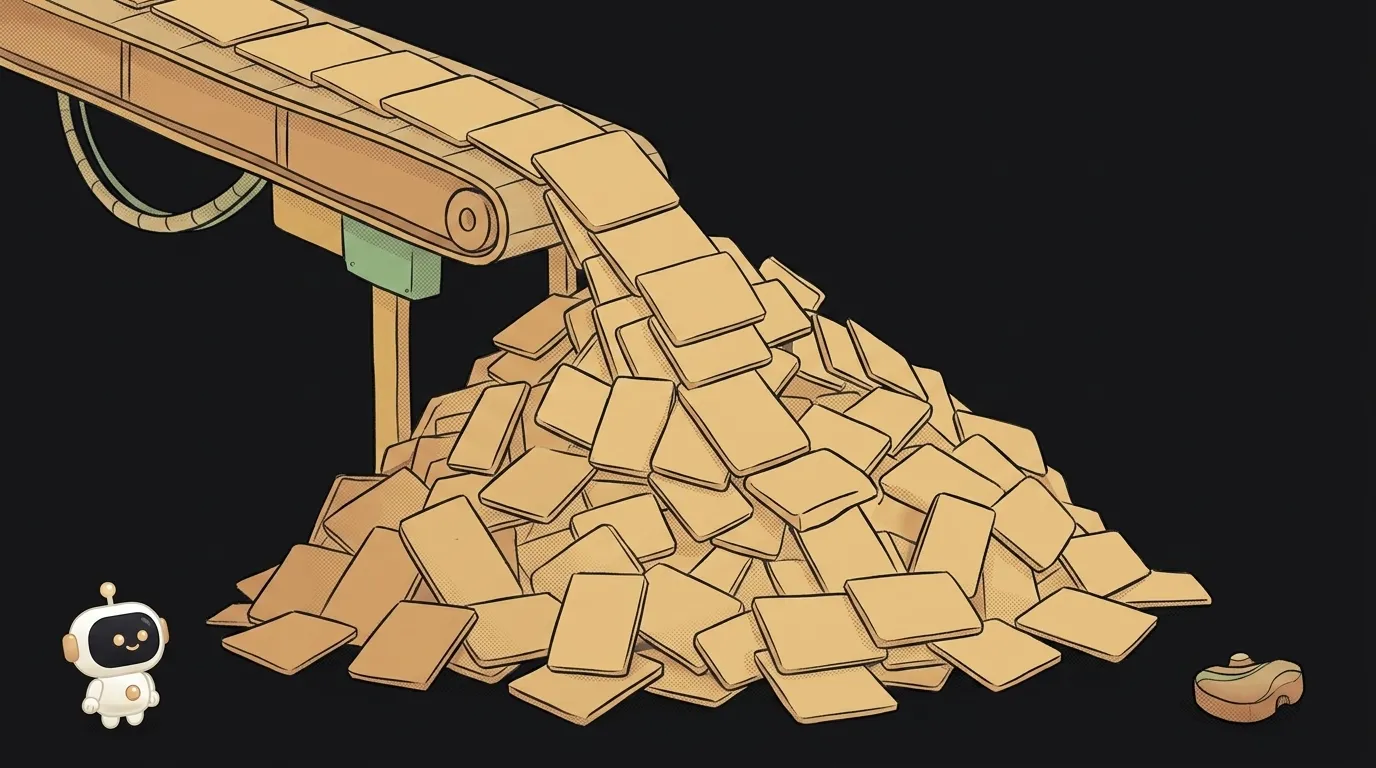
Here's the tricky part. People usually call something «slop» when it reads badly: filler, clichés, mistakes. But the dictionary definition says nothing about quality. It says something else: content the user didn't ask for. Which means a flawless, well-written text can be slop. And a clumsy one with typos can be fine. Let's find that line — you'll need it sooner than you think.
What AI slop means, in plain words
AI slop is content a neural network generated in bulk and dumped somewhere nobody ordered it. Articles, images, videos, reviews, comments, pull requests.
Macquarie Dictionary, which picked "AI slop" as its 2025 word of the year, defines it as low-quality content created by generative AI, often containing errors, and not requested by the user.
Look at that last part. That's the deciding one.
- You asked a model to draft an email — not slop. You're the client, the output is for you.
- Someone generated 400 articles to farm search traffic — slop. Even if they're grammatical.
The difference isn't who wrote the text. It's whether the text has a recipient.
Where the word came from
The word slop is old: in the 1700s it meant soft mud, in the 1800s food waste and pig feed. The meaning was always the same — a shapeless mass someone dumps.
It got attached to AI in 2024, pushed into use by programmer Simon Willison and tech journalist Casey Newton. Then in 2025 something rare happened: three language authorities independently made it their word of the year — Macquarie Dictionary, Merriam-Webster, and the American Dialect Society.
When three dictionaries land on the same word, it's not a meme anymore. It's a diagnosis of the year.
How to tell slop from normal AI-assisted text
It's easy to overcorrect here: «AI wrote it, so it's slop». Not true. KODiQ itself is built with AI, and you'll be working with it too. The tool isn't the question.
The working test is three questions you ask any piece of content:
- Who asked for it? Is there a specific person with a specific need — or was it made «just in case, for volume»?
- What does it add? If you deleted it, would the reader lose anything? Slop restates what's already in the top three search results.
- Did anyone read it before publishing? Slop gives itself away by never being opened after generation: a dead link, «as a language model, I...», an invented fact.
The third one tells you the most. Slop almost always carries a hallucination nobody caught, because nobody looked.
Why this matters to you
You might think: I'm not a media outlet, I'm just learning to build apps. Slop isn't my problem. It is, and here are three places you'll run into it.
App stores. App Store and Google Play prune catalogues of near-identical shells shipped in batches. An app that wraps someone else's API with no value of its own is exactly slop, and review sees it.
Search. SEO stopped rewarding volume long ago. A hundred generated pages about nothing drag the whole site down — including the pages you wrote honestly.
Your own code. This is the ugly one. Vibe coding slides into code slop easily: the model produced five hundred lines, you didn't read them, they «seem to work». A week later you can neither fix them nor explain why they exist.
The antidote is simple and boring: read what you publish. Not «trust the model», not «distrust the model» — just open it and read it before handing it to people. That alone keeps you out of slop territory.
Is it slop just because AI wrote it?
No. The defining trait is bulk content nobody requested. Text a model wrote for your task and you actually checked isn't slop.
How do I know I'm reading slop?
Check whether the text gives you a single concrete fact you couldn't get from the first page of search results. Slop tends to be general phrasing, repetition, and hedged advice like «it's important to consider many factors».
Can code be slop?
Yes, and it happens a lot. If a model generated a large chunk of code and you never read or understood it, that's the same thing — except this one runs in production.
The AI Architect 2027 course: step by step from computer basics to your own app and first customers. 543 short lessons on your phone.
Read next
Ed25519 vs RSA — which SSH key to choose in 2026
What is sudo — and why it asks for your password, not the admin's
What is a tar.gz file — and why a tar archive can be bigger than the files
What is a command-line flag — and why git commit -ma breaks but -am works
scp or rsync — and why rsync sent 141 bytes instead of two megabytes the second time