What is latent space — and why the model isn't drawing a picture
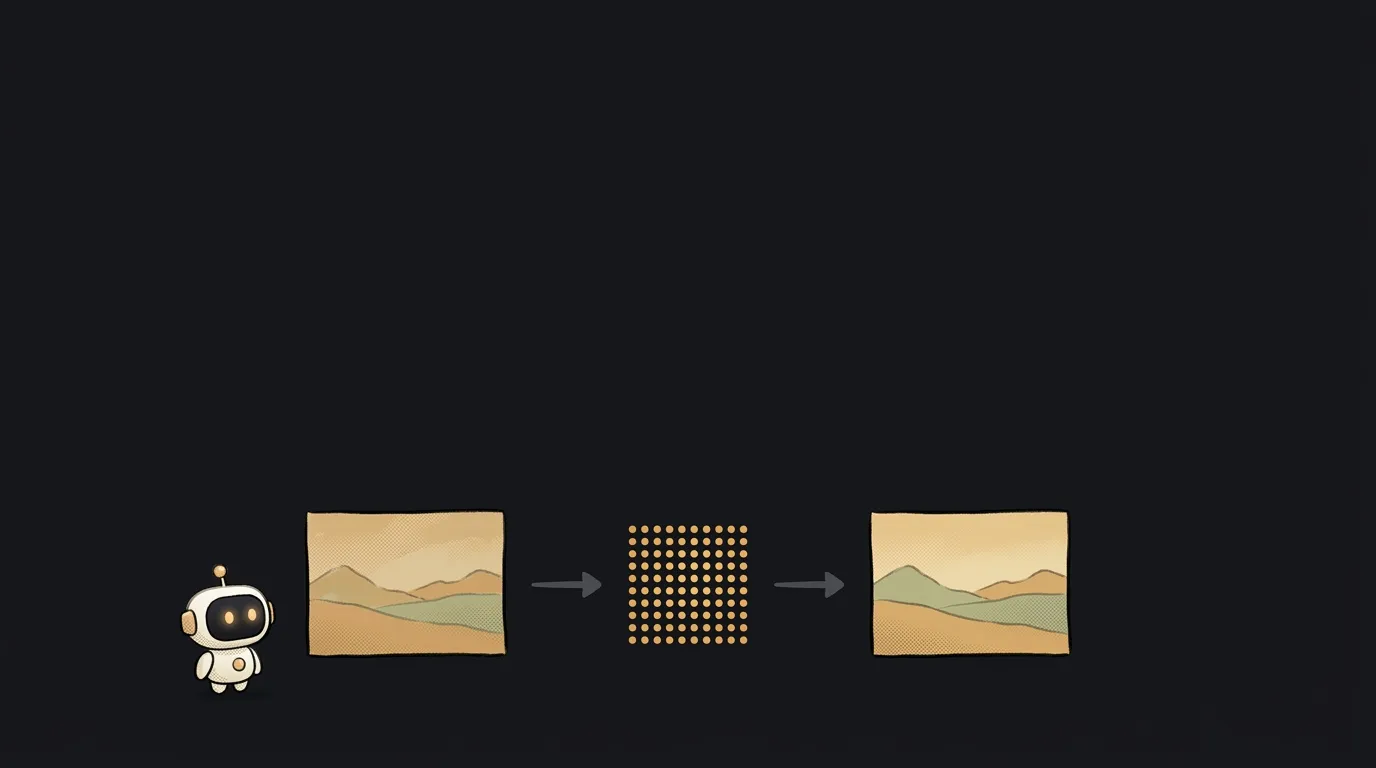
When you ask a model for a 512×512 image, it doesn't draw an image. Almost all of the work happens on something 48 times smaller — a compressed «summary» of the picture. Only at the very end does it unfold that summary into pixels. The place where the summary lives is called latent space. Without it, generating images on a home GPU wouldn't be possible — here's why.
What latent space means, in plain words
Latent space is the model's internal representation, where it stores meaning rather than actual pixels, letters or sound. «Latent» means hidden: you never see it, it's the model's back kitchen.
An analogy. You're retelling a film to a friend. You don't replay it frame by frame — you compress two hours into two minutes: who, where, how it ended. Your retelling is thousands of times shorter, yet your friend gets the point. Latent space is where such retellings live, except they're made of numbers instead of words.
Every image, phrase or track in it is just a set of numbers — a point. Similar things end up near each other, different things far apart.
How it works: 786,432 pixels vs 16,384 numbers
Here's the concrete bit that explains everything. Take classic Stable Diffusion.
- A 512×512 image with three colour channels. That's 786,432 values.
- Before any work, an encoder (VAE) compresses it to a 64×64 grid with four channels. That's 16,384 values.
- The gap is 48×.
All the heavy lifting — repeated denoising — happens on those 16 thousand numbers, not on 786 thousand pixels. At the end, a decoder unfolds the result back into an image.
That's exactly why these models are called latent diffusion — the diffusion happens inside latent space. Remove that trick and a single image needs compute you don't have at home.
You can walk through latent space
The most interesting property: there's a path between points.
Take the point for «photo of a cat» and the point for «photo of a dog», then walk the straight line between them. At every step the model produces a coherent image — a smooth transformation of one into the other. This isn't two pictures cross-faded. These are real points where the model knows how to draw.
Everything you've seen grows out of that:
- Smooth morphing in video generators is movement along such a path.
- Style blending is nudging the point toward another trait.
- Similar images in search are literally neighbours by distance.
The same principle holds for text: embeddings are points in a latent space of meaning, and semantic search looks for nearest neighbours. Different models, one idea.
Where you'll run into this
You'll never touch latent space by hand. But understanding it explains three things beginners complain about.
Why you can't tweak one part of an image without the rest shifting. You're moving the whole point — neighbouring details inevitably drift. Hence all the dancing with masks and inpainting.
Why the model confuses similar things. If two concepts sit close together in its space, it will blend them. Not because it's «dumb» — because to it they're neighbours.
Why the same prompt gives different images. The start is a random point in the space. Pin it down (the seed) and you get a repeatable result.
The practical takeaway: when a result is «almost right», don't rewrite the prompt from scratch. Change one trait at a time — that nudges the point in small steps instead of teleporting to a different district.
Is latent space the same as embeddings?
Almost. An embedding is one specific point (a vector) for one specific object. Latent space is the whole set of those points and the distances between them.
How many dimensions does it have?
Many: from hundreds to thousands. In classic Stable Diffusion the latent is 64×64×4 = 16,384 numbers per image. You can't picture that, but a computer can happily crunch it.
Can I actually look at latent space?
Not directly, but it gets projected onto a plane (with methods like UMAP or t-SNE), producing a map where similar objects gather into visible clusters.
The AI Architect 2027 course: step by step from computer basics to your own app and first customers. 543 short lessons on your phone.
Read next

Ed25519 vs RSA — which SSH key to choose in 2026

What is sudo — and why it asks for your password, not the admin's

What is a tar.gz file — and why a tar archive can be bigger than the files

What is a command-line flag — and why git commit -ma breaks but -am works

scp or rsync — and why rsync sent 141 bytes instead of two megabytes the second time
