Your first AI feature with no key at all — Apple now ships the model inside the phone, free
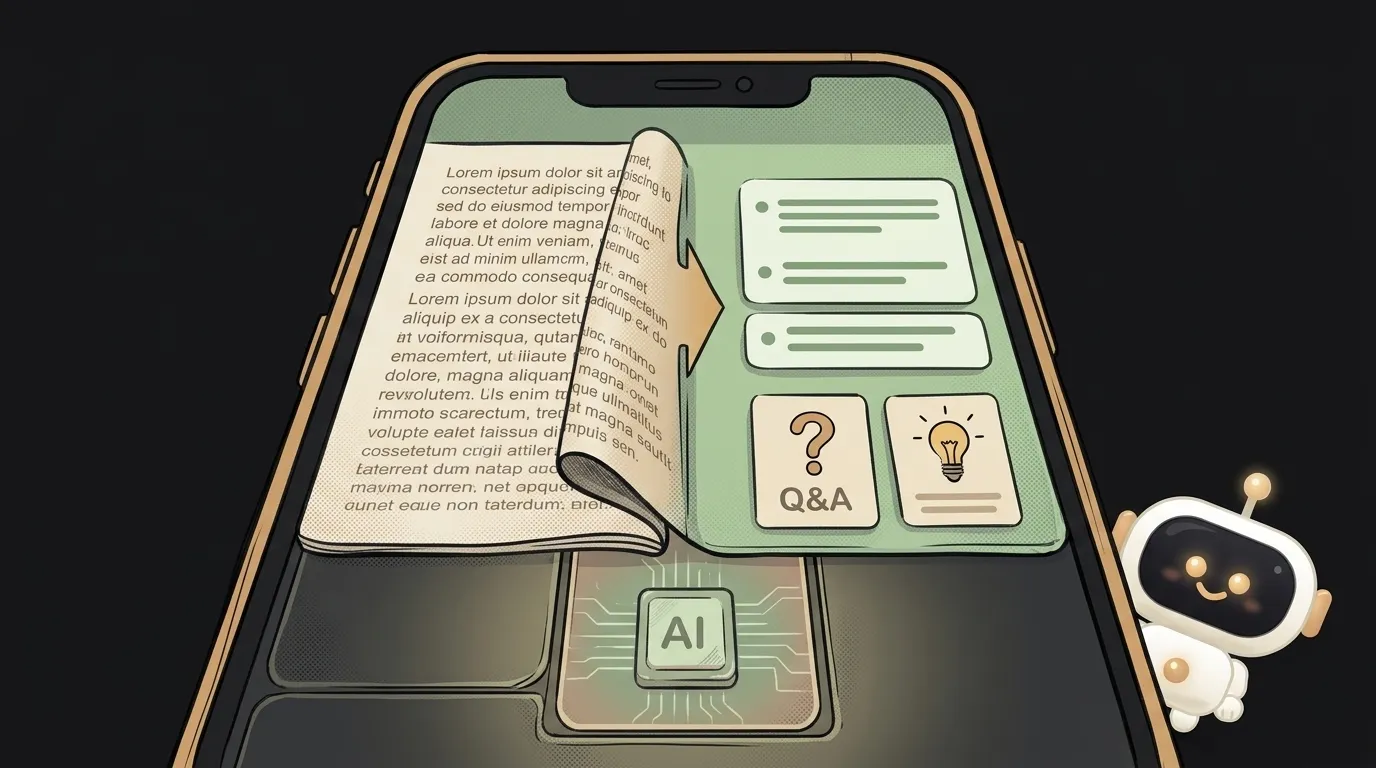
Here's the idea in one line: you share any long article or note into your own app, and it hands back three lines of the gist plus a couple of cards to remember it. No internet, no key, not a cent per request.
And here's the surprising part — there's no key at all. In every other idea here you read the model key from an environment variable. This time the model lives inside the phone: Apple gives it to you in Swift, free, on-device. On June 9 at WWDC they expanded it — added image input and free cloud (Private Cloud Compute) for anyone under two million downloads. So a heavy request can go to the cloud and still cost nothing.
Why this one
Any text is worth "compressing" sometimes: a long article, a thread, lecture notes. But running it through a paid API just for yourself feels wasteful, plus the key wrangling. Here the request never leaves the phone: free, fast, and it works on the subway with no signal. You'll actually use this yourself.
And there's less "magic" than it looks. The app is a pipe: grab the text from the share sheet, hand the built-in model one prompt, show the answer. All the difficulty lives in one good instruction.
What you'll learn
- A model with no key. For the first time you call an AI not over the network with a key, but right on the device. The whole picture shifts: no key to leak, no bill to fear a mistake.
- On-device vs cloud. You'll feel the difference: light work runs on the phone (fast, private, offline), heavy work can go to the cloud. That's a basic choice you'll make in every project.
- "The prompt is the feature." Compressing text isn't a separate technology. It's an instruction to the model: "here's the text, return the gist and cards." A good prompt is your main function.
A ready starter prompt
Don't ask the agent to "make an app with AI" — out of habit it'll reach for a cloud key. Say it plainly: the model is built in, on the device, and spell out the format:
Make an iOS app that summarizes text into a short recap using AI.A strong prompt leaves no room for guessing: it's clear the model is built in, clear which fields you need, clear that it must not invent. The first result lands closer to what you wanted.
What you end up with
You hit a long article — tap "Share → into your app." A second later: three lines of gist and three "question → answer" cards. You flip through them on the subway with no internet, lock in the key points, close it. You didn't pay for the request. You never even pulled out a key — there isn't one.
Start with one screen and one prompt — and you'll have your first AI feature that never got a single bill.
Short story-lessons, an agent simulator and daily practice — in our mobile app. Free.
Source: Apple outlines major AI and developer tool updates at 2026 Platforms State of the Union (MacRumors)
Read next

A web page that watches your camera live — 30 frames a second, offline, no server
Describe a place in words — and hear it. AI now mixes sound as a scene, not clips
Drag a folder — your site is live. No signup needed

One image — and your character talks back, live
One selfie — and you're in any era, with the same face