One AI is confidently wrong — ask three at once and see where they split
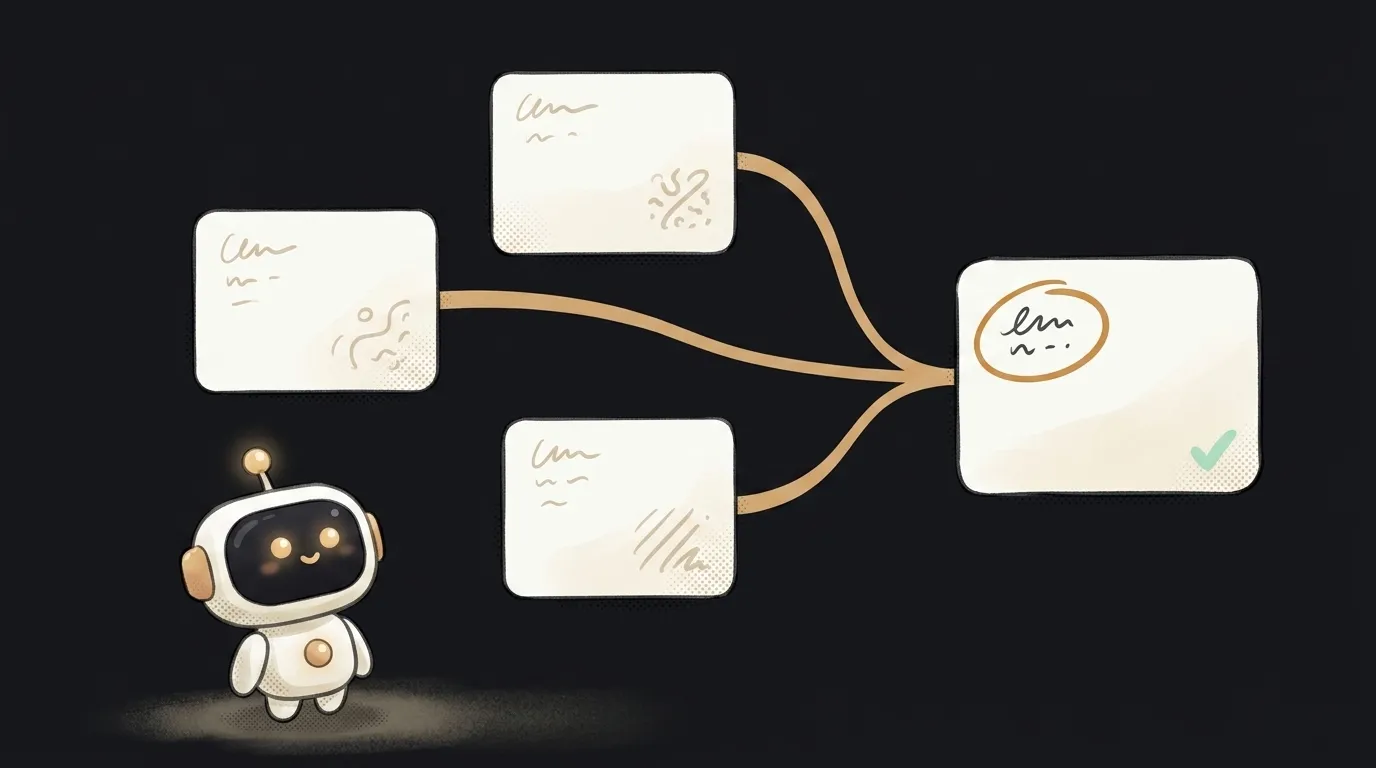
Here's the idea in one line: a bot you ask an important question — and instead of one model, it asks several at once, then hands you a single answer. Plus, separately, it shows you where the models disagreed. Those disputed bits are exactly what you should double-check by hand.
Here's what's new. Until recently you had two options, both meh. Either ask one model — and take it on faith, while it's perfectly capable of being confidently wrong. Or open three tabs yourself, ask the same question three times, and eyeball the answers. Tedious.
On June 13 OpenRouter shipped Fusion. You send one request — and the system fans it out across a panel of models, collects the answers, and a judge model merges them into one. The judge tells you outright where the models agree and where they split. A budget trio — Gemini 3 Flash, Kimi K2.6 and DeepSeek V4 Pro — beat both GPT-5.5 and Opus 4.8 on a deep-research benchmark, coming within a whisker of top-tier Fable 5, all at roughly half the cost of the frontier. That "one dial instead of three tabs" is what the project rides on.
Why this is a good project
It's small, but you'll actually use it — right where the cost of being wrong is high.
- Disagreement is a feature, not a bug. One answer lulls you. Three answers with the split visible are more honest: you instantly see what to re-check.
- There's little magic — it's a pipe. Collect the question, send it to Fusion, show the answer and the list of disagreements. The whole thing is one request.
- A personal use case. A clause in a contract, a symptom, "should I take this mortgage" — questions where you don't want to trust a single model blindly.
What you'll learn
- Hitting one endpoint that hides a whole panel of models behind it.
- Configuring the judge: not "give an answer," but "give an answer AND separately list where the participants disagree."
- Telling a hallucination from a fact — by whether the answer holds across all models or drifts from one to the next.
A ready starter prompt
Don't ask the judge to just "compare the answers" — you'll get a mush of three opinions. Give it a role and an exact output format:
Ask a few models and compare the answers.See the difference? The weak version asks to "compare" — and the model hands back an averaged mush. The strong one sets the judge's role and a strict format: agreement first, then the split, then what to re-check. That third block is what turns a toy into a tool.
What you'll get
You ask: "There's an auto-renewal clause in this contract — am I locked in forever?" The bot thinks for a couple of seconds and answers in three blocks. Up top, the shared answer all models agree on. Below, "two models say you can cancel with 30 days' notice, the third says 60." And at the bottom: "check the notice period in the contract itself — the models split exactly here."
You didn't take one AI's word for it. You saw exactly where they disagree — and knew to read carefully.
Weekend plan
- Saturday. Wire up Fusion, build one "question" field and the three-block output from the prompt above. Run one real question of yours end to end.
- Sunday. Add a question history and a "show each model's raw answers" button — so you can peek under the hood. Let a friend ask their own scary question.
Start with one question and three blocks — after that you won't want to go back to "asked one model and believed it."
Short story-lessons, an agent simulator and daily practice — in our mobile app. Free.
Source: Surpassing Frontier Performance with Fusion — OpenRouter
Read next
47 vacation clips — and an agent cuts them into a video on the beat

Build a “send as-is” button — a model that hands you the email, not advice about it

A song where you change one chord — instead of spinning the generator again

The clip is already rolling — and you call out what happens next

A web page that watches your camera live — 30 frames a second, offline, no server