What is a negative prompt — and why "no text" usually doesn't work
You write: "portrait of a woman, no text in the background." You get a portrait — with a caption in the background. You write louder: "NO TEXT!" The caption gets bigger.
It's not spite. An image model reads your prompt as a description of a scene, not as a list of rules. The word "text" is in there — so text belongs in frame. Negation lands far weaker than you expect.
For bans, there's a separate input. It's called the negative prompt.
Why "no" barely works inside the prompt
Your prompt becomes a set of numbers — a direction in meaning-space. "No text" points somewhere the word "text" is present, and the negation part barely weighs anything.
Humans have the mirror version: say "don't think of a pink elephant" and the elephant is already here. Different mechanics, same outcome: mentioning it summons it.
Hence the first rule that works everywhere: describe what you want, not what you forbid. "A clean, plain wall" instead of "no lettering." "Hands in pockets" instead of "no mangled fingers."
portrait of a woman, no text, no watermark, not blurryNotice the bans didn't vanish — they moved to their own line. That's where they finally earn their keep.
What a negative prompt actually does
It isn't a filter and it isn't censorship on the output. The mechanism is sneakier.
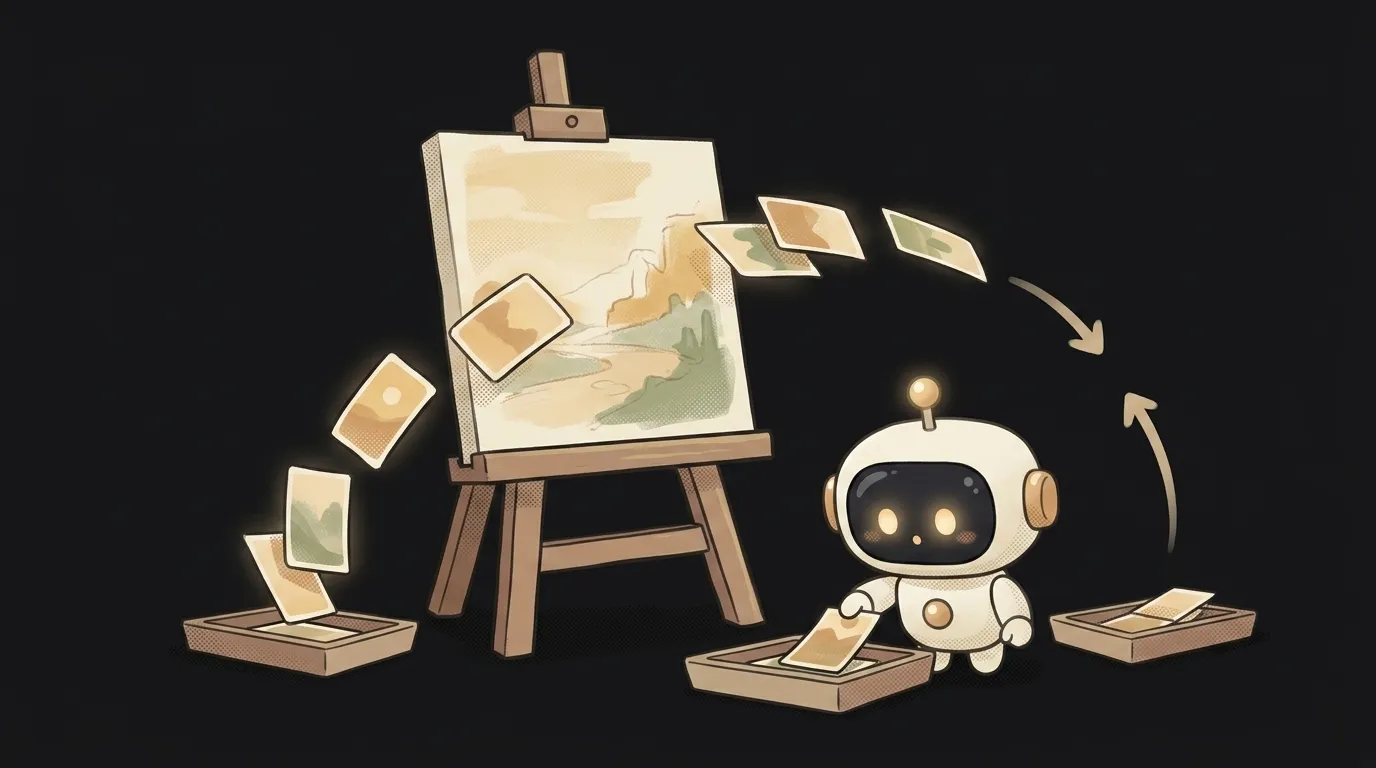
A diffusion model assembles an image out of noise over a few dozen steps. At every step it estimates: "which way do I move to look more like the prompt?"
With a negative prompt, the model computes two predictions: one from your description, one from the forbidden one. Every step, it moves away from the second and toward the first.
So it's not a wall, it's a push-away vector. Two consequences people rarely mention:
- The negative shifts the whole style, not just the banned object. Add
cartoonto the negative and the image gets more photographic everywhere. - A long negative hurts. Fifty words smear the direction and the picture turns flat and "average." Five to ten precise terms beat forty just-in-case ones.
Which tools have the field — and which don't
This is where beginners get confused. The negative prompt isn't a universal AI feature; it's a property of specific tools.
A dedicated field: Stable Diffusion and SDXL — the classic negative prompt box right in the UI, which is where it became a standard. In image APIs it's usually a negative_prompt parameter.
A flag in the prompt: Midjourney — --no at the end: still life --no fruit, apple. The docs add a great detail: --no is equivalent to a weight of −0.5, so it too is a soft push-away, not a ban.
And that's where everyone trips. Midjourney reads the words after --no individually. Write --no modern clothing and the model reads "no modern" and "no clothing." Instead of banning modern outfits, you banned clothes. Say what clothing you do want in the prompt instead of forbidding a phrase.
No field at all: chat models that draw right in the conversation (GPT-Image, Gemini and friends). They have one input — plain text. Bans have to be phrased positively, and that's exactly where "no text" fails.
The good news: instead of a negative, those models give you a dialogue. Don't like it? Say "remove the lettering, the wall is plain concrete," and it repaints.
What to actually put in a negative prompt
A proven baseline for photo and portrait work:
text, watermark, signature, logo, blurry, low quality,
extra fingers, deformed hands, duplicate, cropped, jpeg artifacts
After that, add for your specific problem, not just in case:
- creeping cartoon look →
cartoon, 3d render, illustration; - too glossy →
plastic skin, oversaturated, hdr; - junk in the frame → name it:
chair, curtains.
Keep the order in mind: fix the main prompt first (it drives 80% of the result), then add negatives surgically. A negative prompt is polish, not a life raft. How the main prompt works is covered in our guide to writing a good prompt.
Does a negative prompt work in ChatGPT or Claude for text?
No. Text models have no negative input at all — there you put restrictions straight into the instructions, and models follow them reasonably well. The negative prompt is an image-generation thing.
Why does a long negative list make images worse?
Because it's a direction, not a list of bans. The more words, the blurrier the push-away vector, and the model drifts toward an "average" image. The sweet spot is 5–10 precise terms.
How is a negative prompt different from the CFG setting?
The negative prompt says what to move away from; CFG (prompt guidance strength) says how hard. High CFG amplifies both the positive and the negative: the image follows the description more tightly but loses naturalness.
The AI Architect 2027 course: step by step from computer basics to your own app and first customers. 543 short lessons on your phone.
Read next

What not to paste into an AI chat — 7 things that leave your computer
Why AI answers in English when you write in another language — 3 causes
What is inpainting — and why a mask is a hint, not an eraser
Why AI can't count the letters in a word — it can't see them
How to write image prompts — 5 steps from “draw a cat” to the shot you wanted