What is a random number in programming — and why a computer can't roll a die
Here's a funny thing: a computer is the most predictable machine in the world. The same code with the same data always gives the same answer. That's its main virtue.
But you need a die. A random card of the day, a shuffled quiz, a giveaway winner. How does a predictable machine produce the unpredictable? Honestly — it doesn't. It pretends, very skillfully. And if you understand how, you'll avoid three mistakes AI makes regularly.
What a random number is in code
A random number in a program is a number you can't guess in advance. In JavaScript it comes from Math.random(). Each call returns a fraction between 0 and 1: for example, 0.7318…. Zero can come up, one — never.
But there's no die inside. There's a formula. It takes the previous number, scrambles its bits and outputs the next one. This kind of generator is called pseudo-random — "as if random".
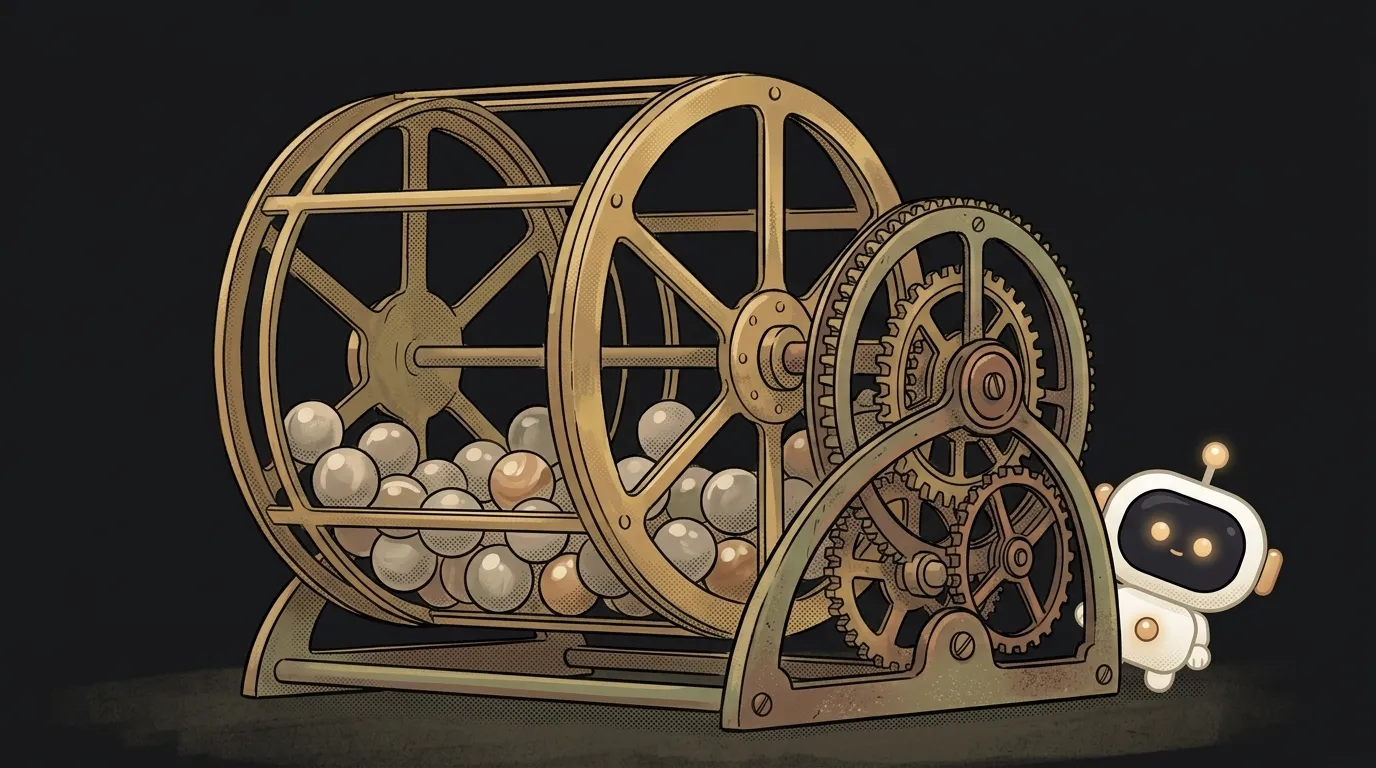
Picture a lottery drum turned by clockwork. The balls bounce around, it looks chaotic. But if you knew how the gears were set at the start, you could say in advance which ball will drop. That starting position of the gears is called the seed.
Turning 0…1 into a useful number
A fraction between zero and one is rarely what you need. You need "1 to 6" or "any item from the list". There's a standard formula for that:
// integer from 0 to n - 1
Math.floor(Math.random() * n)

// a die: 1 to 6
Math.floor(Math.random() * 6) + 1

// a random array item
items[Math.floor(Math.random() * items.length)]
Math.floor chops off the fraction, rounding down. Multiply by six — you get a number from 0 to 5.99. Chop — 0 to 5. Add one — 1 to 6. Every number comes up equally often. If arrays are still fuzzy, that article explains why counting starts at zero.
The Math.round trap
Now for a mistake AI makes all the time. You need a number from 0 to 10, and the model writes:
Math.round(Math.random() * 10)
Looks logical. But Math.round rounds to the nearest. Only the slice from 0 to 0.5 rounds to zero. The slice for one is 0.5 to 1.5 — twice as wide. Ten has the same problem.
We ran this a million times. The numbers 1 through 9 came up 10% each. But 0 and 10 came up 5% each. Half as often. If this is a giveaway, two of eleven participants lose before it starts. And nobody notices — there's no error.
The rule: for random integers, only Math.floor. If you see Math.round next to Math.random, it's a bug.
When you must not use Math.random
The Math.random formula can be worked out. Not by you by hand, but by a determined person with enough observed results — quite possibly. So there are things it must never do:
- passwords and email codes ("your login code: 482913");
- session tokens and password-reset links;
- secret keys — more on that in what is an API key;
- giveaways with money on the line, where someone has a reason to guess.
For those, browsers and Node.js have a cryptographic generator. It draws on real noise from the system and can't be predicted:
crypto.randomUUID()                            // a unique id
crypto.getRandomValues(new Uint32Array(1))[0]  // a random integer
The good news: if you ask an AI to "generate a verification code", it will usually reach for crypto anyway. But check. One sentence in your prompt saves you: "for anything security-related, use crypto, not Math.random".
When randomness needs to repeat
Sometimes it's the other way round: you need randomness you can repeat. A game with a "world code" so your friend gets the same map. A test that shuffles data but always fails the same way — so the bug can be caught.
For that you use a generator with a seed. Same seed — the same chain of "random" numbers, every time. Math.random can't do this: it picks its seed itself and doesn't show it. You need a small library like seedrandom — ask the AI to add it.
By the way, image models have the same seed. Same prompt plus same seed — same picture. It's the same clockwork, just very big. The similar "randomness" knob on text models is called temperature.
Can Math.random return the same number twice in a row?
It can — just like a real die can roll two sixes in a row. If you don't want repeats, it's a different kind of task: not "a random number" but "shuffle the list and take items in order".
Why do the same cards keep ending up on top of my shuffled list?
Most likely the list was shuffled with sort(() => Math.random() - 0.5). It's a popular but unfair method: some positions come up noticeably more often than others. The fair way is covered in how to shuffle an array.
Do I need crypto for a game or an animation?
No. For confetti, a random color or a tip of the day, Math.random is a great choice: fast and simple. Crypto is for places where someone might want to guess the result.
The AI Architect 2027 course: step by step from computer basics to your own app and first customers. 543 short lessons on your phone.
Read next
Ed25519 vs RSA — which SSH key to choose in 2026
What is sudo — and why it asks for your password, not the admin's

What is a tar.gz file — and why a tar archive can be bigger than the files

What is a command-line flag — and why git commit -ma breaks but -am works

scp or rsync — and why rsync sent 141 bytes instead of two megabytes the second time