What is an eval — why topping a benchmark won't solve your task
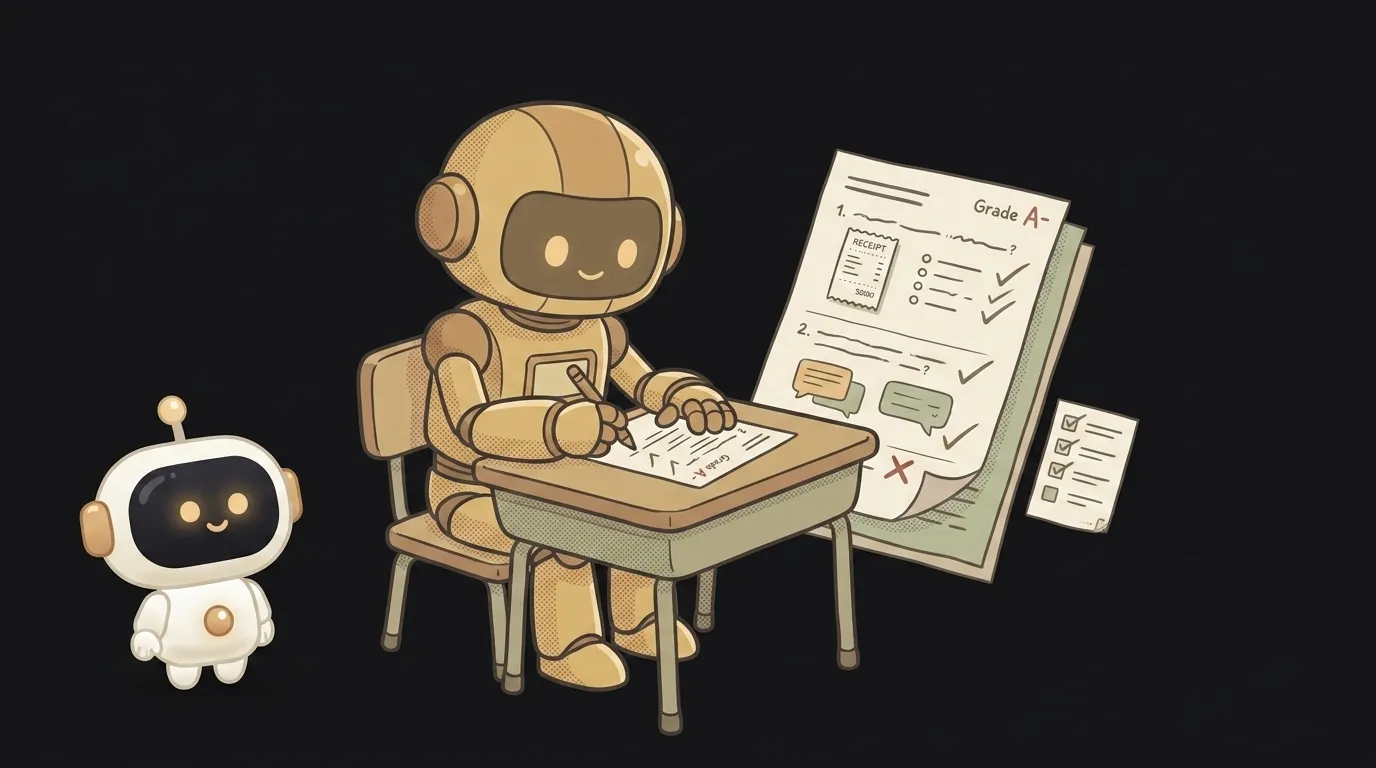
Here's a surprising thing: a model can sit at number one on a global leaderboard and still reliably flunk your specific task. You grab the "best" model, drop it into your app — and it mixes up dates on your receipts or answers in the wrong tone. How?
Like this: the leaderboard measures the model in general, but you need to know how it does specifically for you. That's exactly the gap an eval fills. Let's unpack it and build one in a single evening.
What an eval is in one line
An eval (from evaluation) is a small exam you write for a model, tuned to your task. A set of "here's an input — here's the right answer" examples you use to honestly check whether the model delivers.
A benchmark is a general finals exam for all models at once: math, code, logic. An eval is your personal quiz on one subject: "can the model pull the total off my receipts." The first says the model is smart on average. The second says it works for you.
How it's built
An eval is really just three things.
- A set of examples. You gather 10–30 real inputs from your task. For a receipt bot, a dozen receipt photos. For a support bot, a dozen typical customer questions.
- The expected answer. Next to each input you note what a good answer looks like. Not the perfect wording word-for-word, but the gist: "total is 1240," "tone: polite, no fluff."
- The scoring. You run every example through the model and count how many answers matched. Sometimes you check by eye, sometimes with a second model as judge, sometimes you just check the answer contains the right number.
You get a number: "8 out of 10." On its own it isn't absolute — what matters is how it moves when you tweak the prompt or switch models.
Why it matters to you
It feels like evals are for big AI labs. They're not. The moment your app does anything more serious than "chat," an eval saves you grief.
- It catches the demo-vs-product gap. On three examples in the chat, everything works like magic. On the thirtieth real one, out pops a hallucination or a broken format. An eval shows that failure before users do, not after the complaints.
- It guards against regressions. You tweak the prompt to fix one thing — and quietly break two others. Run the eval and you see it instantly: it was 8 out of 10, now it's 6. Without an eval you'd hear it from an angry customer.
- It helps you pick a model on merit. Not by a leaderboard on Twitter, but by your own 10 examples. Sometimes a cheap model scores the same 9 out of 10 as the expensive one on your task — and you save on every request.
How to build your own eval in an evening
Nothing hard, almost no code.
- Grab a sheet or a simple spreadsheet. One column "input," another "what counts as a good answer."
- Collect 10 real examples from your task. Real, not invented: real ones are where the model trips.
- Run each through the model — by hand or with a short script — and mark whether the answer matched.
- Write down the score. Done, you have a baseline.
Now any prompt change or model swap isn't "seems a bit better" — it's "was 7, now 9." You measure instead of guessing.
An eval turns working with AI from "by eye" into "by instruments." Even a scrappy list of ten examples beats zero: it'll save you, at least once, from shipping a change that quietly broke half your answers.
Are an eval and a benchmark the same thing?
No. A benchmark is general and public, comparing models against each other on standard tasks. An eval is your personal one, checking a single model on your task. Topping a benchmark doesn't guarantee topping your eval.
Does a beginner need an eval?
The moment your app makes decisions for you — yes. While you're just chatting with the model — no. Simple rule: if a user will see the model's mistake, you need an eval.
How many examples are enough?
Start with 10–20. That's enough to catch obvious failures. More examples, sharper picture — but even a tiny eval is radically better than no check at all.
An eval is the habit of measuring instead of believing model marketing. Build your first set of ten examples and you're already ahead of most people picking models by headlines. And figuring AI out step by step is easier alongside someone who explains things like a friend.
Short story-lessons, an agent simulator and daily practice — in our mobile app. Free.