What is Node.js — how JavaScript escaped the browser
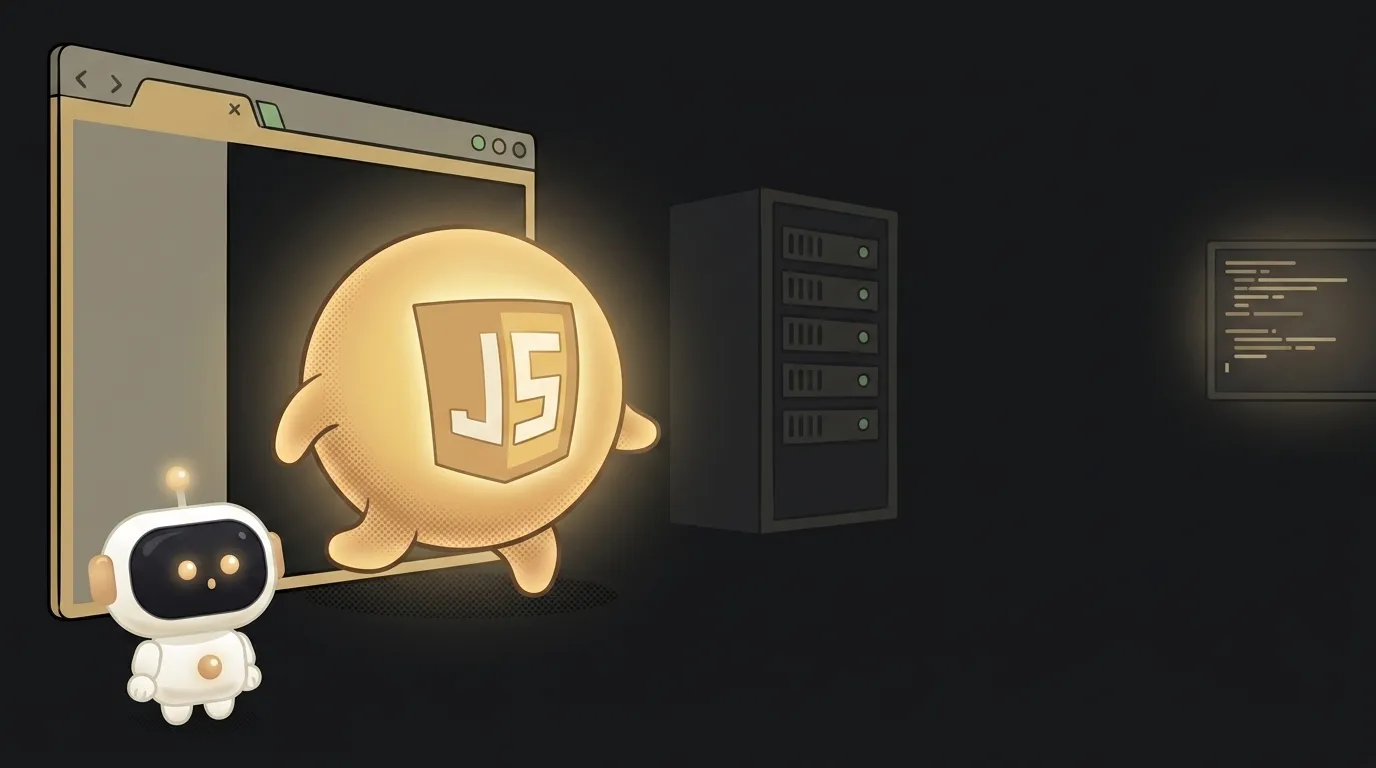
Here's a curious thing: until 2009, JavaScript could only live inside a web page. It lit up buttons and checked forms — and that was it, no leaving the browser. Then Node.js showed up, and the same language that makes a button blink could suddenly run your chatbot's server.
That's the whole point of Node: one language, on the button and on the server. Let's unpack what that means and why you'll need it — even if you just vibe-code on weekends.
What Node.js is in one line
Node.js is the environment where JavaScript runs outside the browser. Not a language, not a library, not a framework. It's a place to run code — in English, a runtime.
An analogy: JavaScript is a fish that used to live only in a tank (the browser). Node is the diving suit that let it walk on land — across your computer, a cloud server, the terminal.
You install Node once. After that, the command node app.js takes your code file and just runs it — no web page involved.
How it works under the hood
A browser can run JavaScript because it has an engine inside — in Chrome it's an engine called V8. The people who built Node took that same V8, pulled it out of the browser, and wrapped it in a standalone program. Then they added what the browser lacks: access to files on disk, to the network, to databases.
Another Node trick: it doesn't wait. An ordinary program, after asking for a file, stands there waiting for the answer. Node instead says "call me when it's ready" and handles other requests in the meantime. This is the non-blocking model, and it's why one modest Node server can juggle thousands of simultaneous connections without choking.
You don't need the details to use it. Just keep the mental picture: the browser's engine + a toolkit for the real world + a habit of never waiting.
Why it matters to you
Three reasons Node will show up almost immediately.
- One language on both sides. Learned JavaScript for buttons on a page? You write your backend in it too. No juggling two languages: the front end and the server speak the same one.
- A huge pantry of other people's code. Node ships with npm — the manager that pulls ready-made pieces into your project with one command: auth, sending email, image handling. You don't build it all from scratch.
- Nearly every AI tool runs on Node. The official OpenAI and Anthropic libraries, tons of bots and agents — most of it is JavaScript, run by Node. Want to wire a model into your app? Almost certainly through Node.
Where you'll meet it in practice
Basically everywhere you build anything more complex than a single HTML page. Every popular website framework — Next.js, Remix, Astro — runs on Node. A Telegram bot in JavaScript — Node. A script that hits an API once a day and sends you a summary — Node.
Even when a builder like Lovable or v0 assembles an app for you "by vibe," Node is almost always spinning under the hood. You might not notice it — but when npm install or node flickers past in the terminal, that's it.
Node doesn't make you a "real programmer," and it doesn't demand months of study. It's just a way to run your JavaScript where there's no browser. Get that one idea, and half the scary terminal commands stop being scary.
Is Node.js a programming language?
No. The language is JavaScript. Node is the environment that runs it outside the browser. Roughly: JavaScript is what you write, Node is where it runs.
Do I need to learn Node separately from JavaScript?
There's no separate "Node language" — you write the same JavaScript. You pick up just a few extras: reading files, standing up a server, installing packages via npm. That's days, not months.
How is Node different from JavaScript in the browser?
The syntax is identical. The difference is what's around it: the browser has a page, buttons and a mouse but no disk access. Node is the reverse — files, network and a database, but no page at all.
Node is the foundation under nearly all of the modern web and most AI projects. Knowing it at the "what and why" level is already half the battle. And building your first app where Node works for you is easiest alongside someone who explains things like a friend.
Short story-lessons, an agent simulator and daily practice — in our mobile app. Free.