A patch from one sentence: the agent draws, the machine stitches
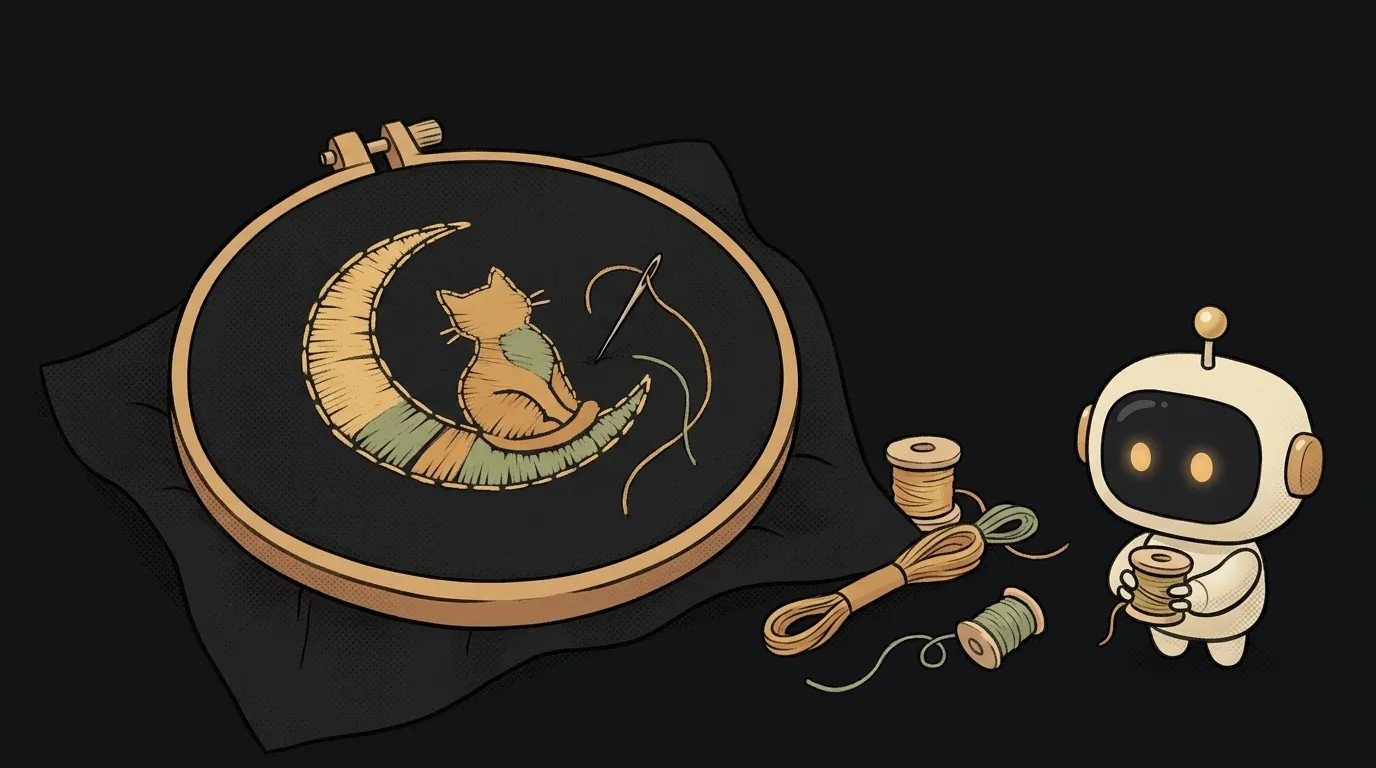
Here is a surprising fact. An embroidery machine does not understand a picture. It needs a file that spells out every stitch: where the needle goes in, at what angle the thread lies, where to trim. Turning a drawing into that file is a craft of its own. It is called digitizing, and people usually pay someone to do it.
On November 12, ZigZag showed up on Hacker News. Its author bought a $300 embroidery machine, and the official app wanted a subscription. So they wrote their own. Free, open source, for Mac, Windows and Linux.
And here is the key part: ZigZag has a built-in agent. That is Claude Code or Codex connected to the editor. They do not generate a picture — they draw shapes and set stitches, the way a person would.
The idea in one line: describe a patch in words — the agent draws it in the editor and prepares a file for the machine. You sew the result onto your backpack.
Where the trick is
The agent uses the same tools you do. Pen, shapes, text, stitch type. Nothing else: no terminal, no access to your files.
That gives you three things:
- You see what it does. The shape the agent is working on shimmers on the canvas, with a label like "Drawing" or "Restyling."
- You can fix anything by hand. It is not an image, it is vector shapes. Do not like the cat's ear? Drag the point.
- The editor checks for you. A line too thin, letters too small, a design that does not fit the hoop — a warning lights up at the bottom.
A year ago an agent could at best generate an image. And an image is not embroidery yet.
What you'll learn
- Giving an agent a task inside someone else's tool. Not "draw this" but "build it from shapes with these stitches."
- Thinking in constraints. Thread is not a pixel: thin details vanish, small text turns to mush.
- Vector graphics. Paths, fills, strokes — the same stuff as icons and logos.
- Taking a project all the way to a thing. Not a file on disk, but a patch you can touch.
A ready starter prompt
Download ZigZag from zigzag.diy. The agent lives inside the editor: the Agent panel on the left, opened with ⌘K. You need Claude Code or Codex that you are already signed in to.
Draw me a nice patch with a cat.Make a round patch 70 mm across for a 4x4 inch hoop. In the center, a cat silhouette sitting on a thin crescent moon, seen from behind, tail hanging down. At most four colors: dark navy background, gold moon, ginger cat, white edge. Background as a fill, edge as a 3 mm satin border, cat and moon as fills with different stitch angles so they catch the light differently. No details thinner than 1 mm and no text. Pick threads from the Brother palette. When you are done, look at the warnings at the bottom and fix them. Then stop and show me the result.The weak prompt gets a drawing the machine will stitch into a mess. The strong one sets what matters for thread: size, hoop, number of colors, stitch types and a ban on tiny details. And it asks the agent to clear the warnings itself.
What you get
The editor window. On the left, the agent panel: "drawing the moon," "setting the stitch angle." On the canvas, shapes appear one by one and shimmer while it works. One warning lights up: "tail too narrow." The agent sees it and makes it wider.
You tap Space — and watch how the machine will sew it: stitch by stitch, in the right order.
Then there are two paths. Have a machine? Export a PES, JEF or DST file and stitch it yourself. No machine? Take the DST file to an embroidery shop. It is the standard format for commercial embroidery machines.
A couple of days later the cat on the moon is on your backpack.
Honest limits
- The agent spends tokens. Every shape is a tool call. A complex patch is a long run.
- Your first patch will come out crooked. Fabric stretches, thread shrinks. ZigZag has test swatches — stitch those on a scrap first.
- Small text is the enemy. Thread blurs tiny letters into mush. The editor will warn you — go big or skip the text.
- It is a fresh project. The author released it recently, so expect bugs.
A neural net draws a picture. An agent in the right tool makes a thing.
The AI Architect 2027 course: step by step from computer basics to your own app and first customers. 543 short lessons on your phone.
Source: ZigZag — an embroidery editor with an agent (GitHub, Show HN 2026-11-12)
Read next
Rehearse your talk out loud — and find where you said something different from the slide
Say “delete the second sentence” — and your email edits itself, no mouse
A story on a dial: move a slider, the text rewrites itself — and checks whether it obeyed
A voice that never existed: describe your hero in words and hear them speak
Your own circuit board in a weekend: the agent routes it, KiCad checks every step