A voice that never existed: describe your hero in words and hear them speak
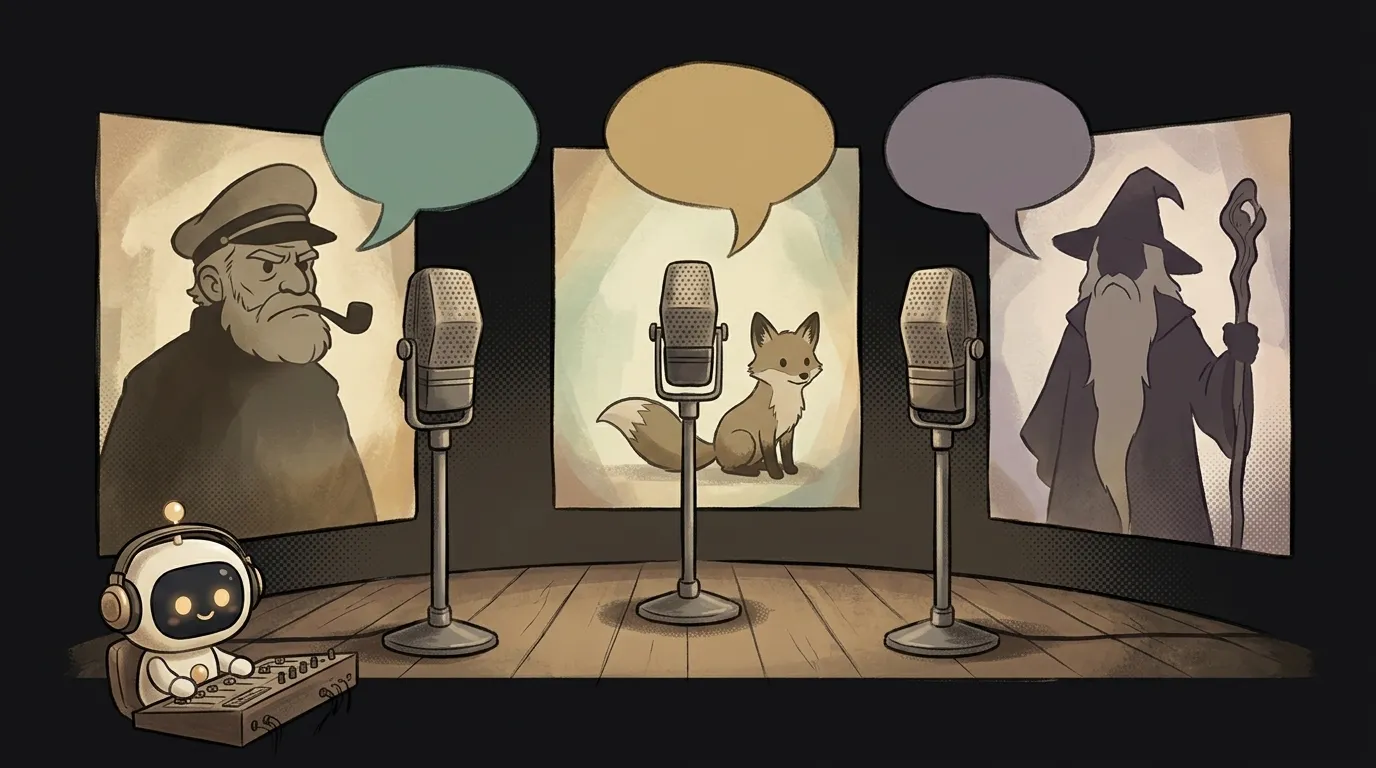
Sound familiar? You write a bedtime story for your little brother. There is a captain, a fox and a wizard. You open a text-to-speech tool and get a list: "Male 1", "Male 2", "Female 3". The captain and the wizard sound like two people from the same call center.
Here is what changed. Gemini now has voice design: you describe a voice in words, and the model creates it. It does not pick one from a list — it makes one. And on November 4 it added remixing: take an existing voice and change it with a sentence.
The idea in one line: a tiny "cast" website. One card per hero, each with a voice description. Press a button and the hero speaks. Then paste a script, and the site assembles a radio play.
Where the trick is
The key word is saved. A created voice gets its own ID like voice_.... It is not a one-off reading — it is a character that lives in your project.
That gives you three things you did not have before:
- The voice does not drift. The captain sounds the same in line one and line twenty. Even a month later.
- You hear it right away. Along with the ID comes a short WAV sample. Do not like it? Rewrite the description.
- Remix instead of starting over. "Same captain, but with a cold." You get a second voice, and the first one stays as it was.
A year ago this meant hiring actors. Or cloning someone's real voice — which is a whole different conversation.
What you'll learn
- Describing sound in words. Timbre, age, pace, manner. It is a prompt, just for the ear.
- Working with an API that has memory. Create a resource, get an ID, reuse it.
- Splitting text by role. A line like
CAPTAIN: Full speed ahead!has to go to the right voice. - Stitching audio. Lines in order, into one file.
A ready starter prompt
A Gemini API key is free in Google AI Studio. Open your agent in an empty folder and give it this:
Make a website that reads a story in different voices.Build a single-page site called Cast in HTML and JS. Take the Gemini API key from an input field and keep it only in page memory. On the right: hero cards with a name and a voice description. A Create voice button sends POST to /v1beta/voices with type prompted and my description, model gemini-3.8-flash-tts. Store the returned voice_... ID in the card and play the sample immediately. A Remix button creates a new voice using this one as the base voice, with my change in words. On the left: a script box in the format NAME: line. A Play button voices the lines in order, each in its hero voice, joins them into one WAV and offers it for download. First read the Gemini docs on speech generation and voices and check the field names. If a name in the script is unknown, highlight the line instead of crashing.The weak prompt gets one narrator and a "read" button. The strong one nails the core: a voice is created once, stored by ID and reused later. And it asks the agent to check field names against the docs instead of inventing them.
What you get
Three cards. In the first you write: "an old sea captain, low raspy voice, speaks slowly as if chewing a pipe." Press the button — a couple of seconds later you hear him. He grumbles.
In the second: "a little fox, quick, bright, a bit sly." In the third: a wizard. Paste the story, press Play. Three voices that did not exist yesterday talk to each other.
Then a remix: "same captain, but young." Now the story has a prologue.
Download the WAV. Send it to your brother. He listens before bed.
Honest limits
- This is not a clone of a person. The voice is invented from a description. Cloning someone's voice without consent is not okay — and here you do not need to.
- Emotion is separate. The description sets the voice itself. "Whispering" or "scared" is a per-line setting, not part of the voice.
- There is a cap. Up to 200 saved voices per project. A voice you do not use is deleted after a year.
- You need Gemini API access. Check that AI Studio works in your country.
A list of narrators gives you a voice. A description gives you a hero.
The AI Architect 2027 course: step by step from computer basics to your own app and first customers. 543 short lessons on your phone.
Source: Gemini API changelog — voice remixing for Gemini 3.8 TTS, November 4, 2026 · speech generation docs
Read next
Rehearse your talk out loud — and find where you said something different from the slide
Say “delete the second sentence” — and your email edits itself, no mouse
A story on a dial: move a slider, the text rewrites itself — and checks whether it obeyed

A patch from one sentence: the agent draws, the machine stitches
Your own circuit board in a weekend: the agent routes it, KiCad checks every step