What is an agent loop — how an AI finishes a task on its own
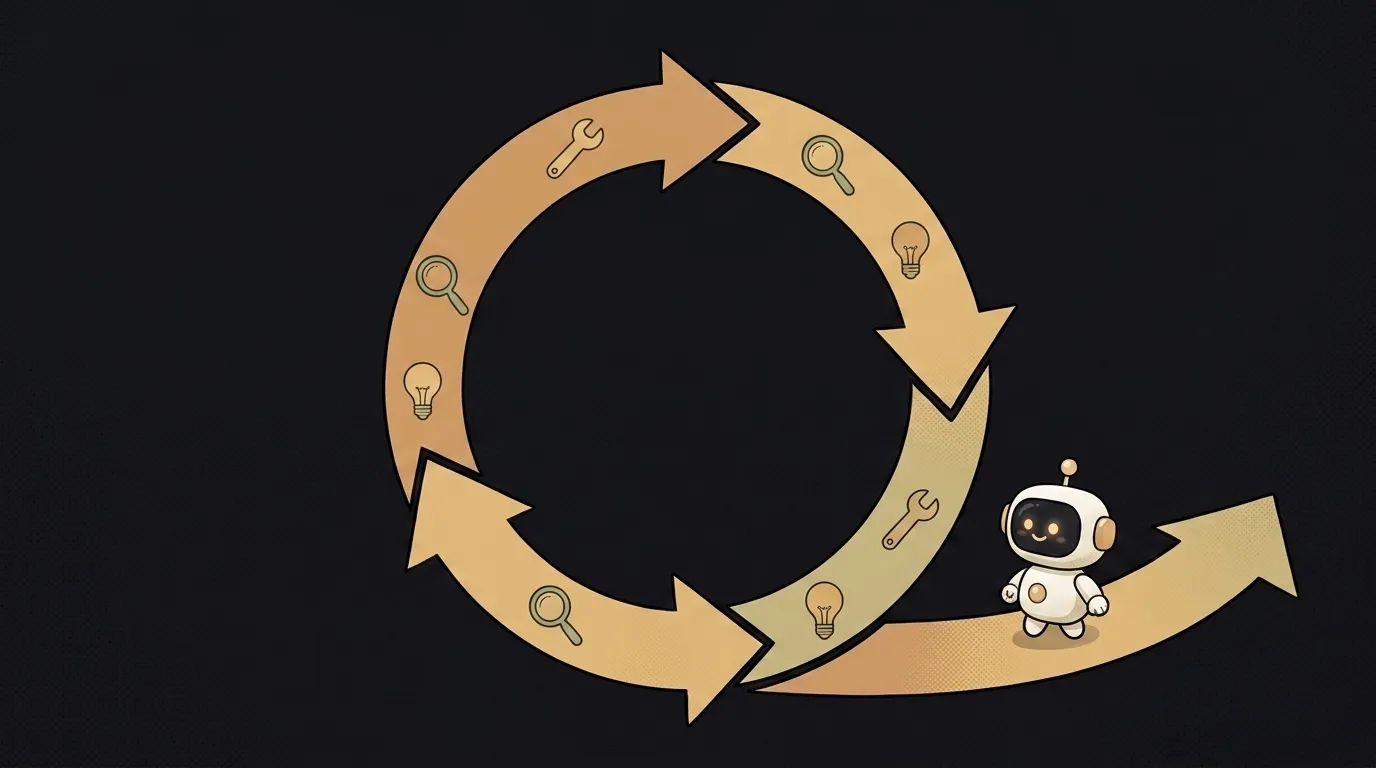
Here's the whole magic of agents, and it's simpler than it sounds. A plain model answers once and goes quiet. An AI agent can't work that way — or rather, won't. It goes round in a circle: it thinks, does something, looks at the result, thinks again — and keeps going until the task is solved. That circle is called the agent loop. Get it, and you get how all these autonomous things actually work.
What an agent loop is
An agent loop is a repeating cycle of three actions that the agent runs over and over until it reaches the goal. Not "one question, one answer," but "small step → check → next step." The model here is the brain that decides, on each lap, what to do next based on what already happened.
The three steps: think → act → observe
Let's break the circle down:
- Think. The agent looks at the task and the current situation and decides: what's the next step? "I need the weather — I'll call the weather tool."
- Act. It performs that step — usually through a tool: opens a site, runs code, reads a file, sends a request.
- Observe. The agent gets the result — an answer, an error, some data — and folds it into its picture of the world.
Then back to step 1, but smarter: now it knows more. Lap after lap — until it sees the goal is reached and stops.
Why without the loop you just get a talker
Picture a bot that can only "think and speak." You ask: "fix the bug in my code." It writes what you might want to change — and that's it. From there you copy, run, catch the next error yourself.
An agent with a loop does it differently: it edits the code (act), runs it (act), sees a new error (observe), edits again (think) — until it works. That loop is what turns agentic AI from an advisor into a doer. The difference isn't the model's "smarts" — it's that it was given a circle to spin and real tools to touch.
Where the loop can get stuck
The circle is a strength and a weak spot. Worth knowing where it trips:
- Looping forever. The agent repeats the same failed step again and again. That's why loops get a lap limit — a fuse against infinity.
- Lost goal. On a long task the agent can forget what it started with, once its memory overflows. Hence all the fuss about agent context and memory.
- Blind trust. It draws a conclusion from a wrong "observation" and confidently drives off course. Good agents double-check the result instead of trusting the tool's first reply.
Knowing these three pits helps: when your agent "hangs" or "goes crazy," one of them is almost always the culprit.
Q: How is an agent loop different from prompt chaining?
You write the order of steps in a prompt chain yourself, ahead of time. In an agent loop the order is decided by the agent itself on each lap, looking at the previous result. A chain is rails you laid. A loop is a car that picks its own road as it drives.
Q: How many laps does an agent make?
As many as it needs, but with a ceiling. A simple task — two or three laps. A complex one (build, check, fix, deploy) — dozens. The developer almost always sets a limit: "no more than N laps," so the agent doesn't spin forever and burn money in an endless loop.
Short story-lessons, an agent simulator and daily practice — in our mobile app. Free.
Read next

What is an Agent Skill — and why it costs almost nothing

What is a subagent — and why it saves context, not time
Agent Skills or MCP — which to choose and how they really differ

Why my MCP server won't connect — 4 causes, most common first
What is AGENTS.md — the file your AI agent reads before you ask