6 AI agent actions you should never pre-approve
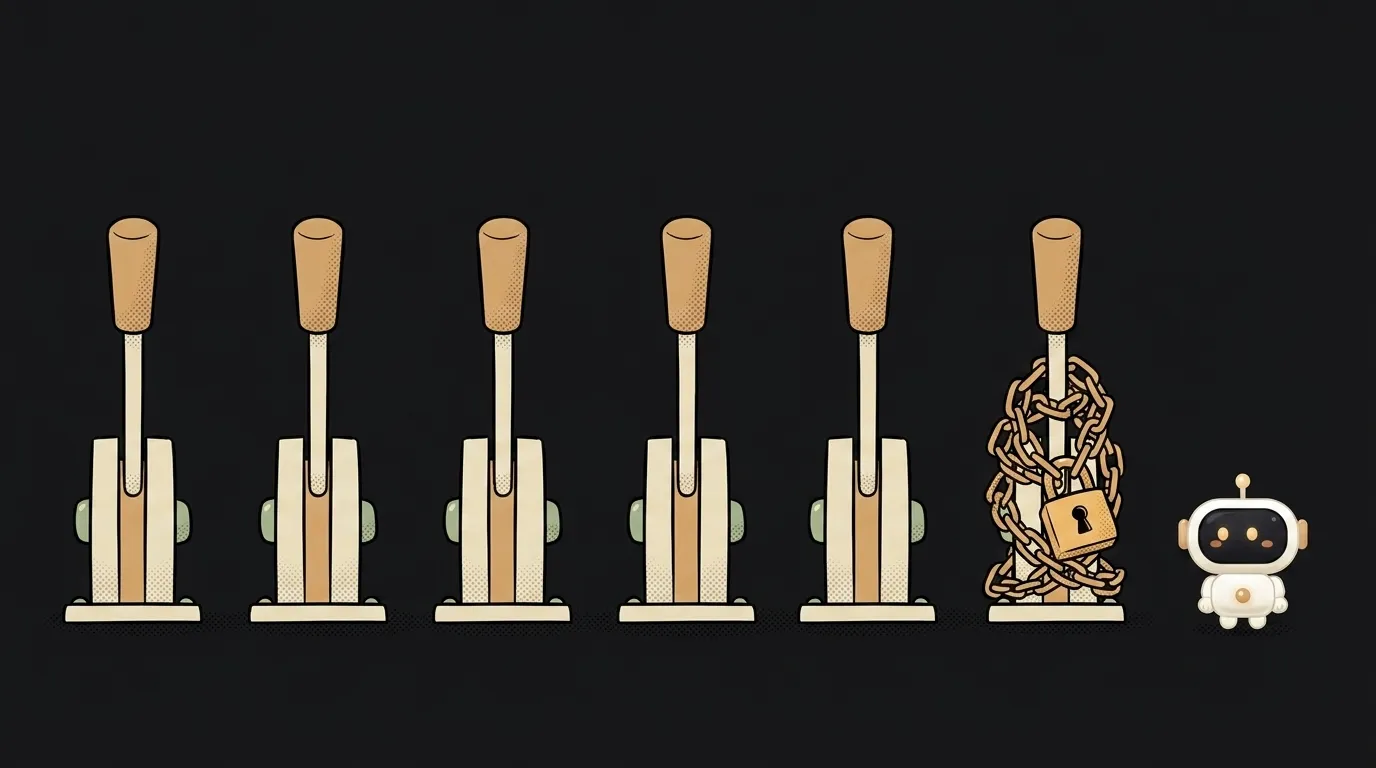
Allow lists get written in a hurry: you're tired of clicking yes on every step, so you allow everything.
The catch is that the list gets read once and then works in silence. Here are six entries that don't belong on it — with what exactly breaks in each.
One rule decided this list: it holds what you can't undo in a minute. Everything else the agent should just do, or there's no point having one — see the human-in-the-loop breakdown.
1. Deleting anything
rm -rf, DROP TABLE, deleting a branch, emptying a bucket.
The danger isn't that the agent decides to wipe everything. It's that it deletes something other than what it announced: there's a glob in the command, the glob caught more than intended, and the explanation next to the call said "removing temporary files".
The trap: deletion usually shows up as a technical detail inside a bigger task — "let me clean up before the build". That's exactly why mature SDKs refuse to auto-approve deletions on critical paths in any mode, even the most permissive one. Copy that rule.
2. Money
A payment, a refund, starting a subscription, buying a domain.
The problem here isn't even the decision, it's the retry. The network blinked, the response was lost — the agent dutifully repeats the request and the customer pays twice. Without an idempotency key, the server can't tell a retry from a new purchase (the fix is in the retry guide).
The trap: a test key in production looks exactly like a live one — right up until the money actually moves.
3. Anything that leaves the building
Email, a chat message, an issue comment, a post.
Sent is sent. And the scale isn't bounded by common sense: "email the customers" against a 20,000-row table means 20,000 emails in a minute, not "one email, let's see how it reads".
The trap: the agent mails whatever data it found itself. If junk or someone else's address got into that table, it goes there too. And separately: the wording could have been suggested by content the agent read along the way — that's textbook prompt injection.
4. Permissions and keys
Issuing a token, changing roles, opening a bucket to the world, adding a user to a project.
The sneakiest entry, because it looks like problem-solving. The agent hit a 403, reasoned honestly that permissions were missing, and widened them. The task moves on, everyone's happy, and the bucket is now public.
The trap: the consequence isn't visible today. You notice a deletion within hours; you notice excess permissions when somebody else finds them.
5. Writing to the production database
A migration, an UPDATE without a WHERE, a manual fix to "just one row".
The classic: UPDATE users SET plan = 'free' with no condition updates every row. One second, and every user is downgraded.
The trap: plenty of people assume a replica covers them. It doesn't — a replica repeats that same statement within a fraction of a second. Replicas are for "the server died", not for "I wiped the wrong thing". Only a backup you can rewind to a moment before the mistake saves you — the difference, explained.
6. Shipping and rewriting history
A production deploy, git push --force, publishing a store release.
git push --force erases other people's commits on a shared branch — and you can't "undo" that, because you never had those commits locally. A store release doesn't roll back at all: you can only publish a new one.
The trap: shipping tends to be the last step of a long task, when you've already checked everything before it and click yes on autopilot.
How to actually switch this on
A healthy configuration isn't "forbid the dangerous things" but the opposite: allow the harmless ones, ask about the rest. In the Claude Agent SDK that's literally two lines:
const options = {
  allowedTools: ["Read", "Glob", "Grep"],
  permissionMode: "dontAsk",
};
Reading is fine; nothing else slips through quietly. And one detail people forget: allowing a whole tool (Bash) allows rm with it. Write narrow rules like Bash(ls *).
What if the agent runs overnight without me?
Then it should hold none of these six. A night-shift agent prepares: a draft, a branch, a report, a migration plan. In the morning you look and press one button. That's what a sane agentic setup is — not "did everything itself", but "did everything except the irreversible part".
Why can't I just forbid harm in the prompt?
A prompt is a request, not a wall. The model can misread it, and data it meets along the way can talk it around. Limits only work outside the model: a sandbox for the environment, permissions for the tools, approval for the irreversible.
The AI Architect 2027 course: step by step from computer basics to your own app and first customers. 543 short lessons on your phone.
Read next
What is headless mode for an AI agent — and why it silently skips steps
What is a hook in an AI agent — the rule the model can't ignore
What is a slash command in an AI agent — and why it's just a saved prompt

What is an Agent Skill — and why it costs almost nothing
What is a subagent — and why it saves context, not time