AI agent vs workflow — when the AI decides, and when to keep it on rails
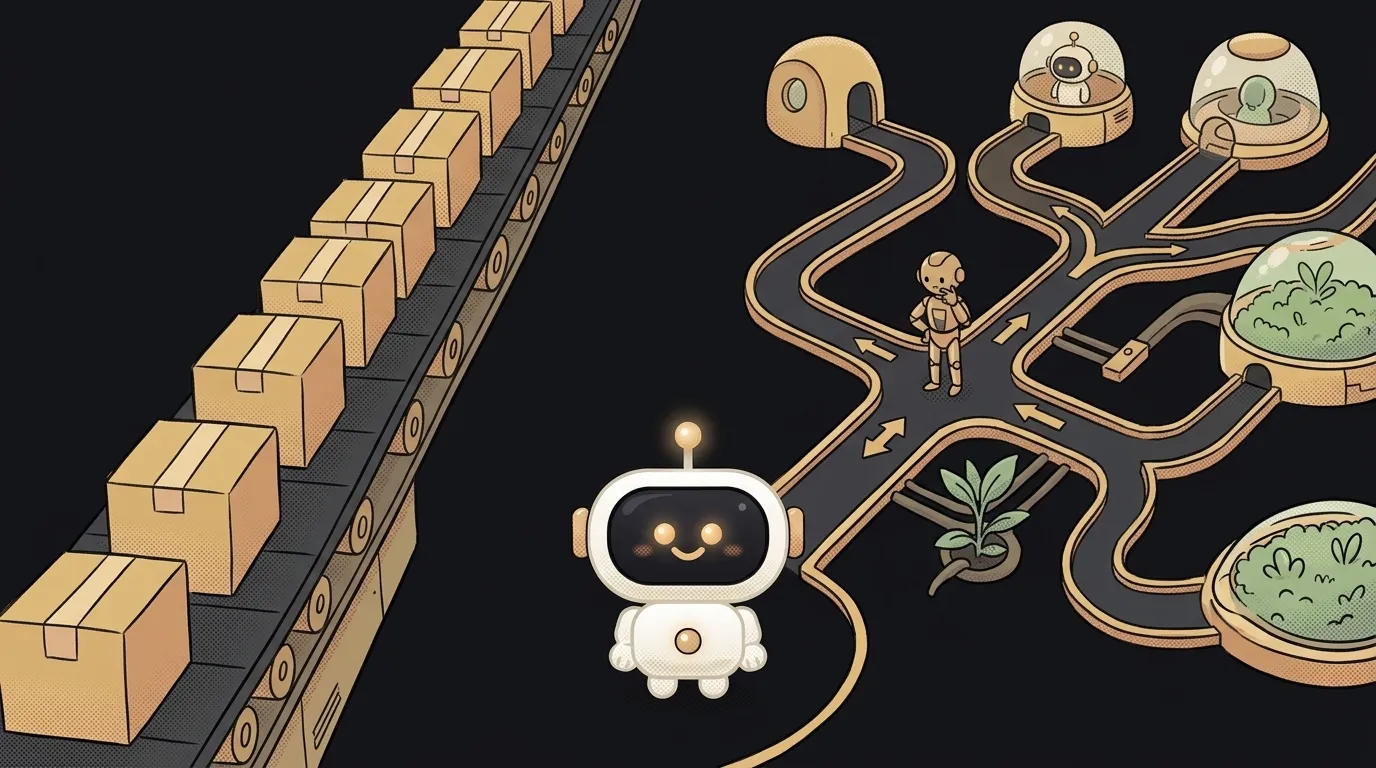
Right now it's fashionable to say “I built an AI agent.” But here's the surprising truth: for most tasks you don't need an agent, you need a workflow — and it'll come out more reliable, cheaper and more predictable. The difference between them isn't about being fashionable but about one question: who decides which step to take next. Let's find the line and pick what fits your task.
In one sentence: who decides the next step
- Workflow — you spelled out the steps ahead of time, and they run on rails, always in the same order. “Take the text → translate it → save to the database.” The model does its job at each step, but you set the route.
- Agent — you give a goal and a set of tools, and the model decides what to do next, in what order, and when to stop. “Deal with this email” — and the agent itself picks: check the calendar, draft a reply, create a task.
Roughly: a workflow is a train on rails, an agent is a driver with a map and a wheel. The train is predictable, the driver is flexible. You pay for flexibility with unpredictability.
Table: agent vs workflow
| Criterion | Workflow | Agent | |-----------|----------|-------| | Who decides steps | You, ahead of time | The model, on the fly | | Predictability | High, always the same | Lower, may go different ways | | Cost per run | Lower (steps are known) | Higher (the model “thinks” and loops) | | Debugging | Simple — you see where it stalled | Harder — the route is new each time | | Fits | A clear, repeatable task | A task with unpredictable branching | | Risk | Won't handle the unexpected | Does extra or wanders off |
Look at the “predictability” row. That's the crux of the choice: a workflow you can guarantee, an agent you can only steer.
When to take a workflow
Take a fixed workflow when you yourself can describe the steps. If a task really can be laid out as “first this, then that,” you almost certainly don't need an agent. Examples:
- An email arrives → pull out the amount → put it in a spreadsheet.
- A user uploads a photo → describe it with a model → save the caption.
- Once a day → gather the news → make a summary → send it to Telegram.
The order is always the same here. An agent would be a cannon at a sparrow: pricier, slower, and sometimes it “gets clever” where you didn't ask. Often such a workflow is just a chain of prompts with a couple of steps in between.
When you need an agent
An agent is justified when you don't know the route ahead of time — it depends on what turns up along the way. The tell: there could be 2 steps or 10, and you can only decide by looking at an intermediate result. Examples:
- “Find out why this test is failing” — how many files you'll open, you can't say up front.
- “Put together a summary of this client” — where to look and how deep to dig depends on what you find.
- “Answer incoming mail and decide what to do with each” — every email leads its own way.
For this to work, an agent needs two things: tools to act with, and context to understand the situation. If a task's branching is unpredictable, an agent is exactly for it. More on the mechanics in what agentic AI is.
Who should pick what (the verdict)
No fence-sitting:
- Beginner, first project → workflow, almost always. It's simpler, cheaper and fully visible. The temptation to “go straight to an agent” is the main trap: you get an unpredictable thing that's hard to debug.
- A repeatable, clear task (reports, processing, mailouts) → workflow, even if it sounds boring.
- A task with real uncertainty (research, fixing, sorting through mixed input) → agent, but build in limits: a step cap, the right to stop, a human check.
- Not sure → start with a workflow. Upgrading to an agent later is cheaper than catching an agent that wandered off.
The rule is simple: take the simplest thing that solves the task. An agent is a powerful tool, but power here also means “more ways to break.”
Is a chatbot an agent or a workflow?
By itself — neither: it's an interface, a window for conversation. Inside it there might be a simple “question → answer” workflow, or a full agent with tools. The “talks vs acts” difference we cover separately in chatbot vs agent.
Can you mix them?
Yes, and in practice people do. Usually the frame is a workflow (reliable rails), and on one or two steps where flexibility is needed, a small agent is slotted inside. That way you keep predictability where you can and hand out freedom only where you must.
Short story-lessons, an agent simulator and daily practice — in our mobile app. Free.
Read next

What is an Agent Skill — and why it costs almost nothing
What is a subagent — and why it saves context, not time
Agent Skills or MCP — which to choose and how they really differ

Why my MCP server won't connect — 4 causes, most common first
What is AGENTS.md — the file your AI agent reads before you ask