Chatbot or agent — what's the difference and what a beginner should pick
"We launched an AI agent" — these days it's slapped on everything, and half of it is really just a chatbot. Marketing has blurred the line so much that a beginner genuinely can't tell: am I building a bot or an agent, and is there even a difference?
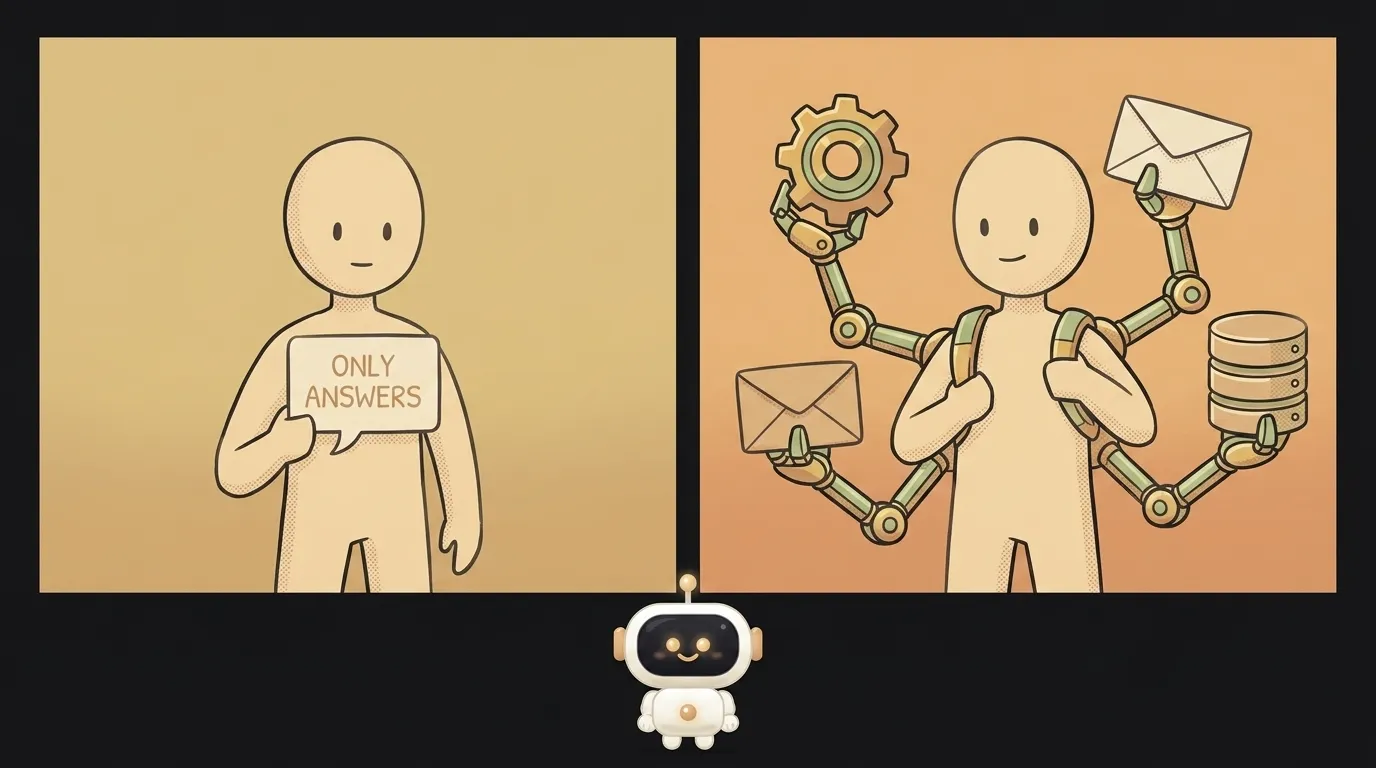
There is, and it's simple. A chatbot answers. An agent acts. A chatbot will tell you how to file a return. An agent will file it. And here's the key: it's not about how "smart" the model under the hood is — it can be the exact same one. It's about whether the AI was given hands. Let's figure out when you need those hands and when a tongue is enough.
In short: the difference
A chatbot is a "question → answer" system. You write a message, it returns text: explains, suggests, finds something in the help docs, drafts something. That's where its job ends — it talks about the task.
An AI agent is a "goal → steps → result" system. It breaks the task into steps, decides what to do next, calls tools (database, calendar, send email), and carries the job to completion, adapting to what comes back. It does the task.
That ability to press buttons in the outside world is called tool use — it's exactly what turns a "talking" model into an "acting" agent.
Table: chatbot vs agent
| Criterion | Chatbot | Agent | |-----------|---------|-------| | What it does | Answers messages | Carries a task to a result | | Output | Text: answer, draft, suggestion | Action: record created, email sent | | Tools | Usually none (text only) | Yes: API, database, files, browser | | Autonomy | Low — waits for each message | Higher — plans and walks the steps | | Memory of the task | Chat history | Task context + intermediate results | | Build complexity | Low — an evening | Higher — needs tools and guardrails | | Main risk | Answers inaccurately | Does the wrong thing — harder to undo | | Cost per request | Cheaper (one pass) | Pricier (many steps and calls) |
The key row is risk. A chatbot's mistake is a bad answer, easy to ignore. An agent's mistake is a performed action: an email sent, a record deleted, money charged. That's why an agent needs guardrails — confirmations on dangerous steps and limits.
Where you see it in an example
Take an online store's support.
Chatbot: "How do I return an item?" → "Go to Orders, pick the item, hit Return, the money arrives in 5 days." Useful, but you do all the work.
Agent: "Return my last order" → finds the order in the database, checks the return is still allowed, files the request, initiates the refund, sends you a ticket number. You pressed nothing — the result is closed, not the question about the result.
You can see the agent is harder not in the model but in the wiring: it needs access to orders, to payments, and a safeguard against returning the wrong order. Often these tools are connected via MCP — a shared standard for giving an agent hands.
What to pick
No fence-sitting — here's the direct call.
Pick a chatbot if:
- the task ends in an answer: FAQ, explanation, draft, document search;
- the cost of a mistake is just inaccurate text;
- you're a beginner and want a first working result by tonight. Start here — it's the honest start.
Pick an agent if:
- you need an action from the AI, not text: create a record, send, update, book;
- the task has several steps where decisions are made along the way;
- you're ready to invest in tools, limits, and confirmations on dangerous steps.
Practical advice: almost always start with a chatbot. Polish the "talking" version, learn exactly where an action is needed — and only then give the bot hands in one or two specific spots. An agent grown out of a working chatbot is more reliable than one built "to sound trendy."
FAQ
Can I turn a chatbot into an agent later?
Yes, that's the normal path. An agent is essentially a chatbot that was given tools and the right to act step by step. If you already have a working chatbot, adding tool use in one place (e.g. "create a record") is evolution, not a rewrite from scratch.
Is an agent always better, since it can do more?
No. "Can do more" means "can break more" and "costs more." For a task that ends in an answer, an agent is extra complexity and risk with no upside. The best choice is the simplest tool that closes the task.
Is an LLM-based chatbot already an agent?
No. An LLM chatbot generates smart text, but it still only answers. It becomes an agent the moment it gets tools and starts performing actions in the outside world rather than describing them. A smart model is necessary but not sufficient.
Short story-lessons, an agent simulator and daily practice — in our mobile app. Free.
Read next
AI agent vs workflow — when the AI decides, and when to keep it on rails
What is an agent loop — how an AI finishes a task on its own
What is a sandbox — and why it's safe to let an AI agent run code
API or webhook — what's the difference and when to use which
RAG or long context — paste your documents in or search through them