What is open source — and why it doesn't mean 'free'
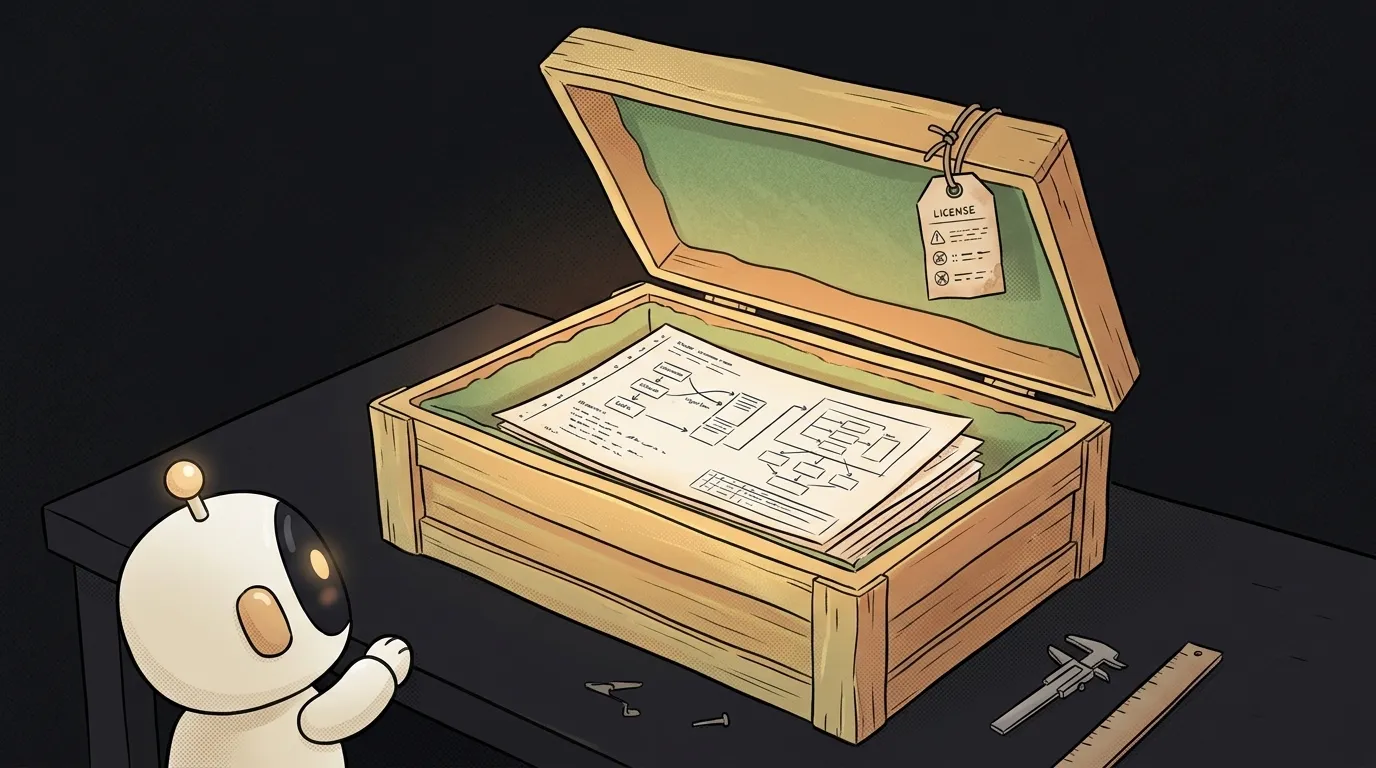
"Open source" sounds simple: "code everyone can see." But there's a triple confusion hiding here that trips up almost every beginner. Open source is not a synonym for "free," not "do whatever you want," and not "no rules." The opposite, really: open code almost always comes with a license, and that license decides what you may and may not do.
What open source means, in plain words
Open source means the author has published a program's source code out in the open: come in, read it, copy it, change it. It usually lives in a public repository on GitHub — anyone can download it and see how it works inside.
The opposite is closed (proprietary) code. You use the program, but you can't see what's under the hood: Windows, iOS, the ChatGPT app. It works — but the source is locked away.
Almost every tool you touch daily stands on open source: your browser, Git, Python, React, thousands of libraries you pull in with a single line. Open code is the foundation of modern development, not a rare curiosity.
Open ≠ free ≠ no rules
Here's where intuition breaks. Three things that feel like one are actually different:
- Open — you can see the source.
- Free — you don't pay to use it.
- Unrestricted — you can do anything you like with the code.
They often overlap, but they don't have to. There's open code you can't use commercially. There's free software with tightly closed source. "Open" is only about the source being visible. Everything else is about the license.
Where the license comes in — and how to read it in a minute
A license is a note from the author: "here are the terms for using my code." Without a license, you technically can't take the code at all, even if it's sitting right there. You don't need to read the whole thing — just recognize a couple of common ones:
- MIT, Apache 2.0, BSD — the most generous. Take it, change it, sell it, drop it into your project. The one condition is usually: keep the author's credit. For a side project or a business — green light.
- GPL, AGPL — "contagious." You can do everything, but if you use this code, your project also has to become open on the same terms. Fine for a home project, a trap for a closed product.
- No LICENSE file — that means "all rights reserved." You can look, you can't copy.
The practical skill: before pulling someone's code into your project, open the LICENSE file in the repo and glance at the first line. Thirty seconds saves a pile of trouble later.
Open weights are not open source
Here's the sneakiest trap of the AI era. When people say "open source model," they almost always mean open weights — you can download the trained model and run it yourself. But that's not the same as open source in the strict sense.
With true open source, everything is open: the source, and you can reproduce the program from scratch. With an open-weights model, only the "result" is open — the numbers themselves. The training code and, more importantly, the data it was trained on are usually closed. Plus the license may restrict things: banning use by giants or in certain fields.
So it's more honest to say "open weights" than "open source model." The difference between open and closed models is a spectrum, not two camps: "open, with strings attached" is a real thing.
FAQ: is open source safe?
More yes than no — for a surprising reason. Because thousands of people see the code, holes in popular projects get found and fixed faster than in closed ones. But "open" doesn't mean "someone checked it for you": a tiny library with no stars may have no review and no support. Simple rule — look at popularity and the date of the last update.
FAQ: can you make money from open source?
Yes, and whole companies are built on it. The code is open, but they charge for hosting, support, a cloud version, or enterprise features. Open code and business live together just fine — it's not charity.
Short story-lessons, an agent simulator and daily practice — in our mobile app. Free.
Read next

What is a string in programming — and why "5" and 5 aren't the same
What is return and a return value — and why console.log returns nothing

What is a boolean — and why the string "false" is actually true
for loop or map — which to use, and why await inside map doesn't wait

What is scope in programming — and why a variable is "not defined" when it's right there