What is a multi-agent system — and why five narrow AIs beat one do-it-all
It sounds logical: give an agent more tools and it gets stronger. In practice, the opposite. An agent with twenty tools gets dumber: it gets lost in its own context, confuses which tool does what, and starts missing. Five narrow agents, each with one job, hold their focus. That's the idea of multi-agent — sometimes a "team" of AIs is smarter than one genius.
What a multi-agent system is
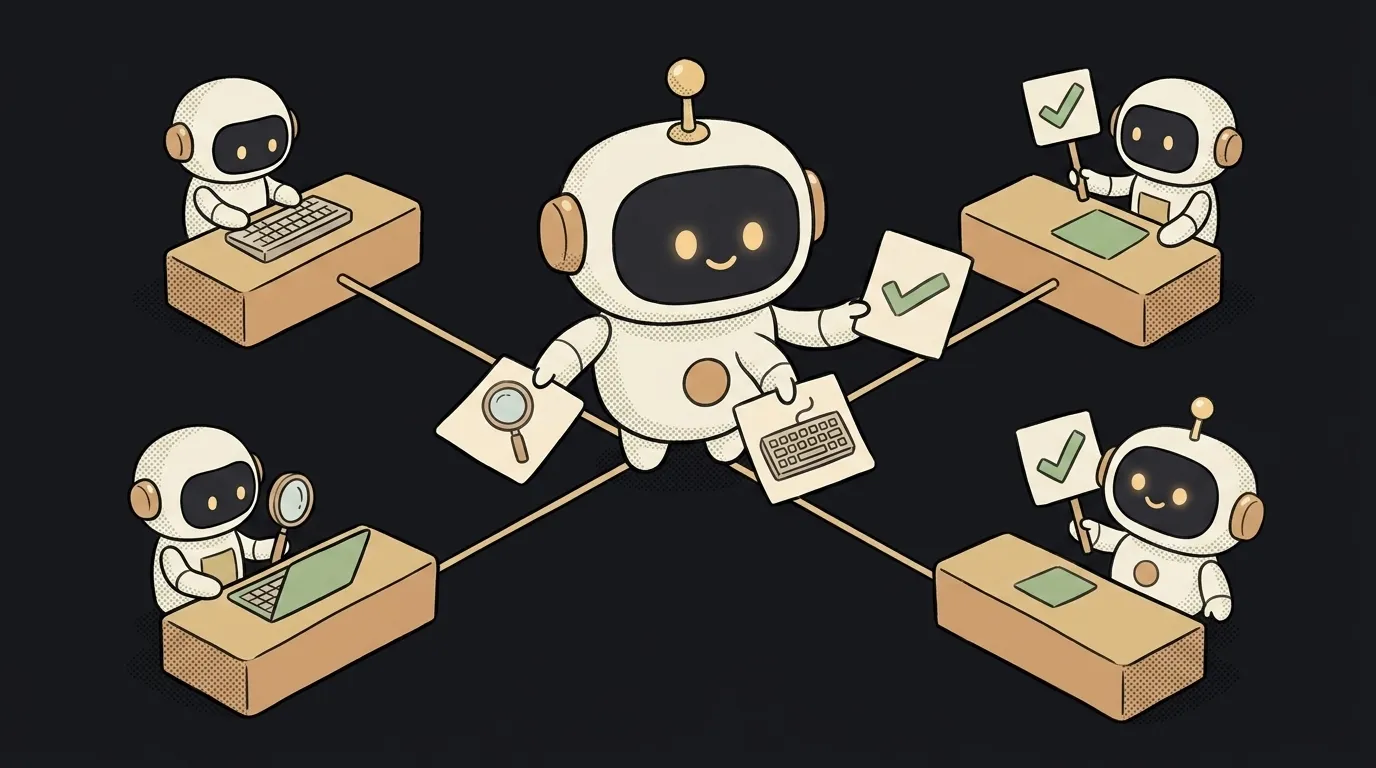
Multi-agent means several AI agents, each with its own role and its own set of tools, working on parts of one task and exchanging results. Instead of a single do-it-all worker — a small team of specialists.
Simple analogy: a one-person band versus a newsroom. One person juggles text, photos, and layout — and is mediocre at all of it. A newsroom splits it: a reporter writes, a photo editor picks images, a proofreader cleans up. Each is narrow, so each is good at their piece.
How it works
Usually there's an orchestrator — a lead agent that breaks the task into chunks and hands them to worker agents. Each worker then does its thing:
- one searches for information,
- another writes code,
- a third checks the work for mistakes.
Results come back to the orchestrator, which merges them into a single answer. Sometimes agents loop: write → check → rewrite.
The main technical win is context isolation. Each agent has its own clean window, filled only with what its role needs. One agent doesn't clutter another's context. To plug agents and tools in by a single standard, teams often use MCP.
When you actually need it
Multi-agent shines in three cases:
- Parallel broad search. You need to sweep a topic from many angles — launch several searchers at once, each digging its own corner. Faster and more complete than one going in turn.
- Separable roles. The task honestly splits into "find / do / check" — and the roles don't get in each other's way.
- Adversarial review. One agent proposes, another tries to refute it. That catches mistakes one agent can't see in itself.
And when you don't
Here's the honest part the hype forgets: more agents isn't always better. You pay for the team in coordination.
If the task is simple and linear ("rewrite this text," "answer this question"), multi-agent only adds latency and doubles the bill for tools and tokens. Agents spend steps handing context to each other, and sometimes argue or duplicate work. One good agent here is faster, cheaper, and more predictable.
The rule of thumb is simple: ask yourself — can the chunks be done in parallel and independently? If yes, a team is justified. If the task is one chain of steps, take a single agent.
How is multi-agent different from one agent with tools?
A single agent keeps everything in one head and one context: it decides which tool to call. In multi-agent the roles are spread across separate agents, each with a clean context — which saves you when the tools and steps grow too many for one.
Does multi-agent always give a better answer?
No. On complex, divisible tasks, often yes. On simple ones it's just pricier and slower for the same quality. Complexity costs money — add it on purpose.
Is it hard for a beginner to build?
The skeleton itself (an orchestrator plus a couple of workers) goes together on ready-made frameworks. But start with one agent: get it right, hit its ceiling — and only then split into a team.
Short story-lessons, an agent simulator and daily practice — in our mobile app. Free.
Read next
AI agent vs workflow — when the AI decides, and when to keep it on rails
What is an agent loop — how an AI finishes a task on its own
What is a sandbox — and why it's safe to let an AI agent run code
API or webhook — what's the difference and when to use which
RAG or long context — paste your documents in or search through them